Six Eras of Anime in a Comic Grid
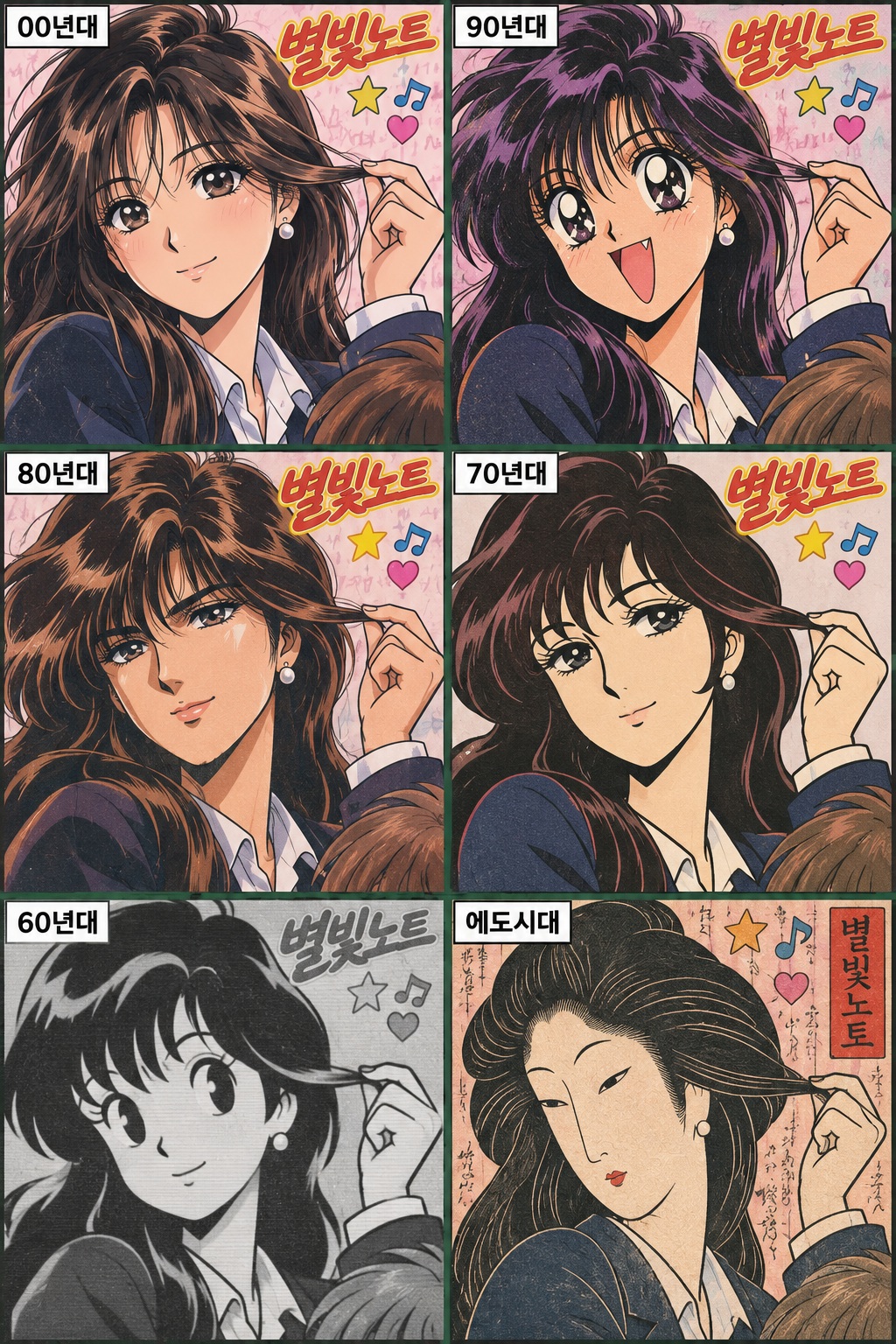
Create a six-panel illustration that redraws the same person and scene in five anime-era styles and Edo-period ukiyo-e.
Example outputs
Prompt template
- Format
- Text
- Inputs
- Face_reference_photo (image) · Required
- Outputs
- Illustration (image)
TASK {
  Create ONE single image: a 2-column x 3-row comic grid (portrait 2:3 canvas, 6 equal panels separated by thin dark-green borders).
  All 6 panels show the SAME person in the SAME composition and pose, but each panel is drawn in the anime/illustration style of a different era.
  The joke is "the same scene redrawn by each era". Composition stays identical; only the drawing style changes.
  The whole image is illustration. No panel may look like a photograph.
  Generate everything in one pass.
}

INPUT_PHOTO {
  The uploaded photo is a face reference only.
  Take ONLY the shape of the eyes, nose and mouth from the photo, plus the hairstyle (length, cut, parting) and hair color.
  Do NOT take from the photo: head angle, head tilt, face direction, gaze direction, expression, face outline/jaw shape, skin rendering, lighting, background, clothing.
  Head angle, gaze and expression come ONLY from this prompt.
  If the person is male, draw a male version in every era style. Do not feminize.
}

IDENTITY_LOCK {
  Redraw the face outline to fit each era's style, but lock the facial features to the original:
  - eye shape (upturned/downturned, monolid/double eyelid, roundness), eye size relative to the face, distance between the eyes
  - nose length, width, bridge height, tip shape
  - mouth width, lip thickness, lip shape
  - the relative size, spacing and vertical position of eyes, nose and mouth
  No beautifying, no averaging, no symmetrizing, no generic "anime default face".
  Each era's conventions decide HOW the features are drawn (line weight, highlights, simplification), not WHAT they look like.
  The person must be recognizable as the same individual in all 6 panels, carried as far as each style allows.
}

SHARED_COMPOSITION {
  Framing: tight close-up from the chest up. The head is large and fills the left-center of the panel.
  Head: three-quarter view facing slightly toward image-left, eyes looking at the viewer, head tilted very slightly. Identical in panels 1-5.
  Hand: the subject's hand rises at image-right beside the head, pinching and lifting a strand of their own hair with thumb and index finger. If the hair is short, the hand lightly pinches a lock at the side of the head.
  Outfit: dark navy blazer over a white collared shirt. The sleeve cuff is visible on the raised hand.
  Lower right: a friend leaning in from below. Only the top of their brown hair is visible; the face is completely hidden. Never give the uploaded face to this friend.
  Background: a pop magazine/poster collage. Pale pink-white paper with repeated faint lettering, a big hand-lettered red title logo with a yellow outline in the upper right, plus a small yellow star, a blue music note and a pink heart floating near the top. The logo is an original made-up title; never use any existing anime, manga or brand title or logo.
  Era label: a small white rectangular tag in the top-left corner of each panel with black text (see PANELS).
  Body proportion: adult 8.5-head proportions implied (only the bust is visible).
}

PANELS {
  P1 (top-left) label "00년대" {
    2000s digital cel anime. Thin clean lineart, large glossy eyes with several soft highlights, soft pink blush on the cheeks, a tiny simple nose, a small mouth, smooth soft-gradient shading, bright clean saturated colors.
    Expression: gentle closed-mouth smile.
  }
  P2 (top-right) label "90년대" {
    1990s hand-painted cel anime. Huge sparkling eyes taking up much of the face, big white highlights and star glints, thick upper lashes, a small pointed chin, slightly grainy film texture, violet-tinted saturated palette.
    Expression: overexcited wide open-mouth grin with one small pointed fang showing.
  }
  P3 (middle-left) label "80년대" {
    1980s anime. Sharper and more angular face, nose drawn with a visible shading shape, voluminous hair with big swept bangs and banded hair highlights, detailed iris, glossy lips, airbrushed cheek shading, warm slightly faded VHS-like colors.
    Expression: calm, faint knowing smile.
  }
  P4 (middle-right) label "70년대" {
    1970s anime. Longer face, horizontally long eyes with a defined eyelid line and drawn lower lashes, small mouth with lightly colored lips, flat cel colors with no gradients, thicker outlines, matte slightly yellowed print colors.
    Expression: soft confident smile.
  }
  P5 (bottom-left) label "60년대" {
    1960s black-and-white TV cartoon. Entirely grayscale (the background too). Very simple rounded shapes, round black eyes with one white highlight dot, minimal nose, a single curved line for the mouth, flat gray tones, thick uniform outlines, soft broadcast blur and film grain.
    Expression: simple happy smile.
  }
  P6 (bottom-right) label "에도시대" {
    Edo-period ukiyo-e woodblock print (bijin-ga). Pale powdered white face, narrow slit eyes looking downward, a long thin nose line, tiny red lips, small eyebrows painted high on the forehead, an elongated face, hair as a flat glossy black mass with fine combed lines, flat woodblock colors, washi paper texture.
    Head in the classic ukiyo-e three-quarter view with downcast eyes, in the same position and size as the other panels; the hand still pinches the hair.
    Background becomes washi paper with vertical pale-pink paper strips of brush calligraphy and a red vertical title cartouche; the star, note and heart remain as flat woodblock shapes. The blazer stays (part of the joke).
    Expression: serene, aloof.
  }
}

RULES {
  Same composition, hand pose, outfit and element placement in all 6 panels. Only style and expression change.
  Each panel must strongly commit to its era style; never blend styles between panels.
  Labels must be exactly: 00년대, 90년대, 80년대, 70년대, 60년대, 에도시대.
  No extra text, captions, speech bubbles or watermarks besides the labels and the made-up title logo.
}
What you'll create
Six equal panels show a shared person and composition in era-specific drawing treatments. Thin dark-green borders and exact Korean labels distinguish the decades and Edo-inspired panel within one illustrated canvas.
Usage instructions
Provide a photo for the face-reference features and hairstyle; the prompt specifies the pose, expression, outfit, and scene separately. The six labeled panels keep a shared composition while changing visual style and expression; the Edo-period panel has its own specified downcast gaze and background treatment.
Frequently asked questions
May one panel remain photographic?
No; every panel must be illustration.




Comments
Tried this prompt? Share what you made, compare results, or ask a question