Midnight Rain Reflections Portrait
Create a cinematic, photorealistic nighttime portrait of a person watching city lights through a rain-covered window, using their uploaded photo as the identity reference.
Example outputs
Prompt template
- Format
- Text
- Inputs
- Uploaded_person_photo (image) · Required
- Outputs
- Portrait (image)
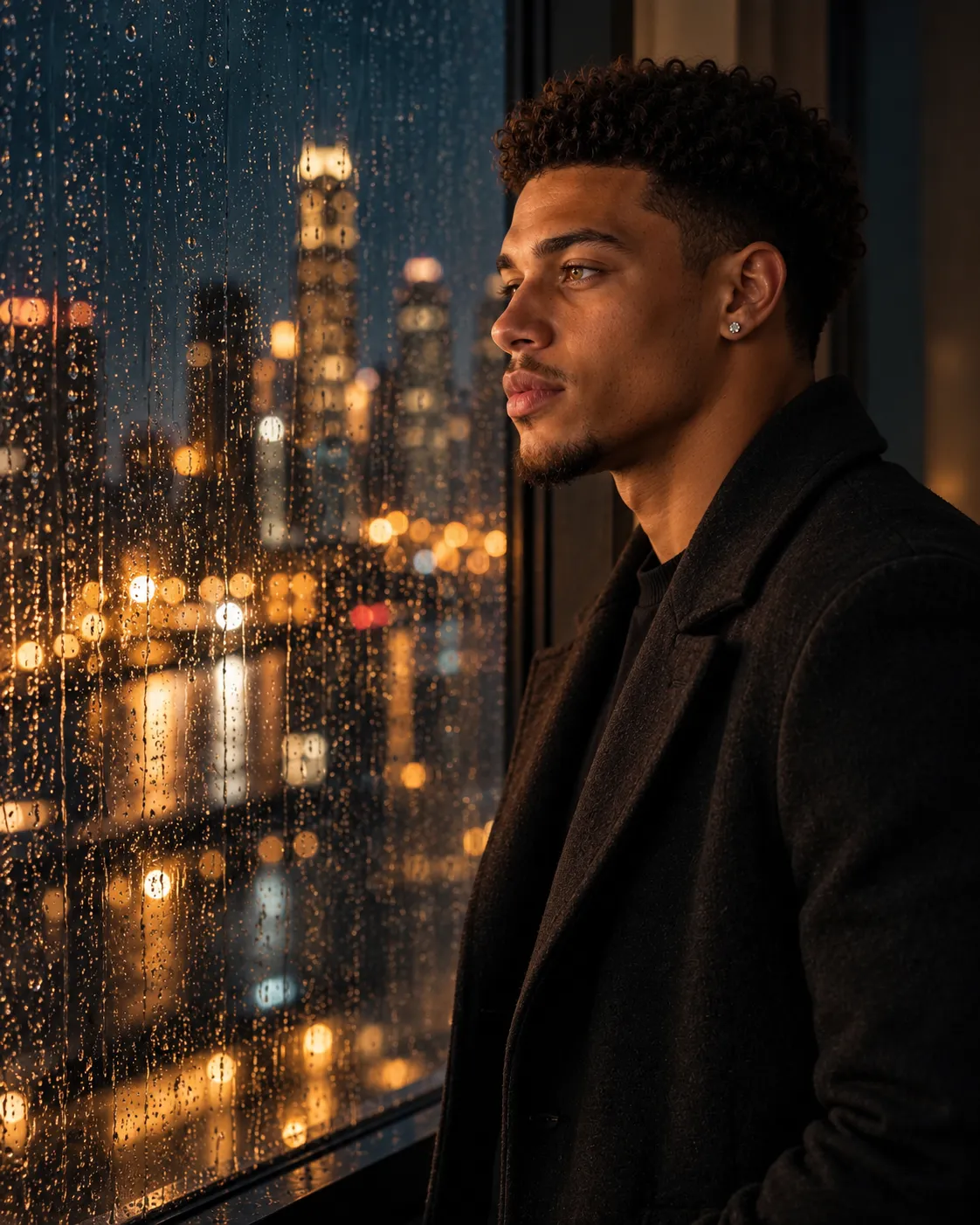
Create an ultra-photorealistic, cinematic nighttime portrait of a contemplative adult standing beside a rain-covered window, silently watching the glowing lights of a city at night. Use the uploaded photograph as the sole authoritative facial identity reference. Preserve the person's recognizable facial structure, apparent age, natural skin tone, eye colour, hairline, hairstyle, facial hair if present, nose, lips, cheekbones, jawline, and distinctive characteristics. Do not replace their identity with a generic model, artificially de-age them, excessively beautify them, or substantially reshape their face.

Position the subject on the right side of the composition, indoors and standing close to a tall window. Their body faces slightly toward the window, with their head turned approximately 75–85 degrees away from the camera to create a dramatic near-profile view facing left. Give them a serious, thoughtful, introspective, emotionally restrained expression, with their gaze resting on the distant city lights beyond the glass. Maintain natural posture, relaxed shoulders, and a quiet sense of solitude.

Dress the subject in a dark charcoal or black tailored overcoat with broad lapels, layered over a dark shirt. Keep the clothing sophisticated, understated, and realistic, with detailed fabric weave, natural folds, subtle seams, and physically accurate material textures. Adapt the hairstyle and facial hair to the identity reference rather than copying another person's features.

Use a vertical 4:5 cinematic portrait composition, photographed from indoors at approximately the subject's eye level. Position the camera slightly behind and to the subject's left, facing diagonally toward their near-profile and the rain-covered window.

Use a full-frame camera with an approximately 50mm portrait lens at f/1.8–f/2.2, ISO 800–1600, and a 1/125-second shutter speed. Maintain realistic optical perspective, natural facial proportions, cinematic compression, and shallow depth of field.

Place the subject in the rightmost 35–40% of the frame. Keep their entire head, including all hair or headwear, comfortably inside the image. Show them from above the head down to approximately the waist or lower torso, allowing the dark coat to merge naturally into the shadowed lower foreground.

Let the rain-streaked window dominate the left 55–60% of the image, with softly blurred city lights beyond it. A vertical section of glass covered in sharply rendered droplets should separate the subject from the luminous background.

Set the scene in a dimly illuminated modern apartment, hotel suite, or high-rise interior overlooking a city during a rainy night. Outside, distant streetlights, buildings, traffic, and illuminated windows dissolve into large circular bokeh highlights.

Create realistic raindrops, condensation, tiny beads of water, irregular vertical streams, and delicate reflections across the window glass. Some droplets should be sharply defined, while others dissolve naturally into the shallow focus. Keep the distant city deliberately indistinct, with overlapping amber, honey-gold, and muted cream bokeh circles against deep teal-blue and nearly black shadows.

Use dramatic, low-key cinematic nighttime illumination. Warm amber city light enters through the rain-covered glass, gently illuminating the subject's forehead, brow, nose bridge, cheekbone, lips, and jawline. Keep the camera-facing side of the subject predominantly in deep, soft shadow, with subtle reflected highlights defining the facial contours.

Use a sophisticated teal-and-amber colour palette: deep petrol blue, desaturated turquoise, warm tungsten gold, muted bronze, charcoal black, and subtle olive-green undertones. Maintain rich blacks without crushing essential facial detail, softly graduated shadows, restrained highlights, delicate reflections, and a natural cinematic dynamic range. Avoid bright studio lighting, harsh flash, excessive saturation, artificial rim lighting, or evenly illuminated facial features.

Render exceptionally detailed natural skin with realistic pores, subtle imperfections, fine facial hair, believable subsurface scattering, authentic eye reflections, detailed eyelashes, individual hair strands, and accurate facial anatomy. Preserve true-to-life coat materials, realistic fabric thickness, stitching, folds, and environmental reflections. Reproduce physically convincing water droplets, glass refraction, natural light diffusion, optical bokeh, subtle film grain, and realistic lens behaviour. Keep the subject's visible eye and illuminated facial profile crisp and natural, while the background lights remain beautifully defocused.

Create a hauntingly beautiful, emotionally cinematic atmosphere suggesting solitude, reflection, nostalgia, and the quiet passage of time. The image should resemble a carefully composed frame from a premium dramatic feature film. Maintain strong negative space, visual balance, believable scale, natural photographic imperfections, and restrained professional colour grading. Use a vertical portrait composition with full-frame height emphasis and a cinematic poster layout.

Do not include text, typography, logos, or watermarks. Avoid artificial skin smoothing, cartoon effects, illustration, and painterly rendering.

-- ar 4:5
What you'll create
An adult stands on the right indoors, turning into a near-profile view toward the left. Rain on the tall window and glowing city lights support a quiet, emotionally restrained nighttime scene.
Frequently asked questions
Which direction does the face turn?
Toward the left, away from the camera in a strong near-profile view.
What expression is requested?
Serious introspection rather than an exaggerated emotional display.




Comments
Tried this prompt? Share what you made, compare results, or ask a question