Three Aces in a Wild West Saloon
Create a cinematic, photorealistic Western portrait of a person throwing three specific aces in an ornate 19th-century saloon, while preserving their appearance from a reference photo.
Example outputs
Prompt template
- Format
- Markdown
- Inputs
- Reference_photo (image) · Required
- Outputs
- Western_portrait (image)
Create an ultra-photorealistic, cinematic 4:5 vertical color portrait of the person in the uploaded reference photograph, seated at a poker table inside an authentic 19th-century Wild West saloon. Faithfully preserve the subject's recognizable facial identity, natural facial structure, apparent age, skin tone, eye color, eyebrows, nose, lips, jawline, hairline, hairstyle, facial hair if present, and distinctive individual features. Do not beautify, de-age, reshape, replace, or reinterpret their appearance. Adapt the Western clothing naturally for male or female subjects.

SCENE AND COMPOSITION:

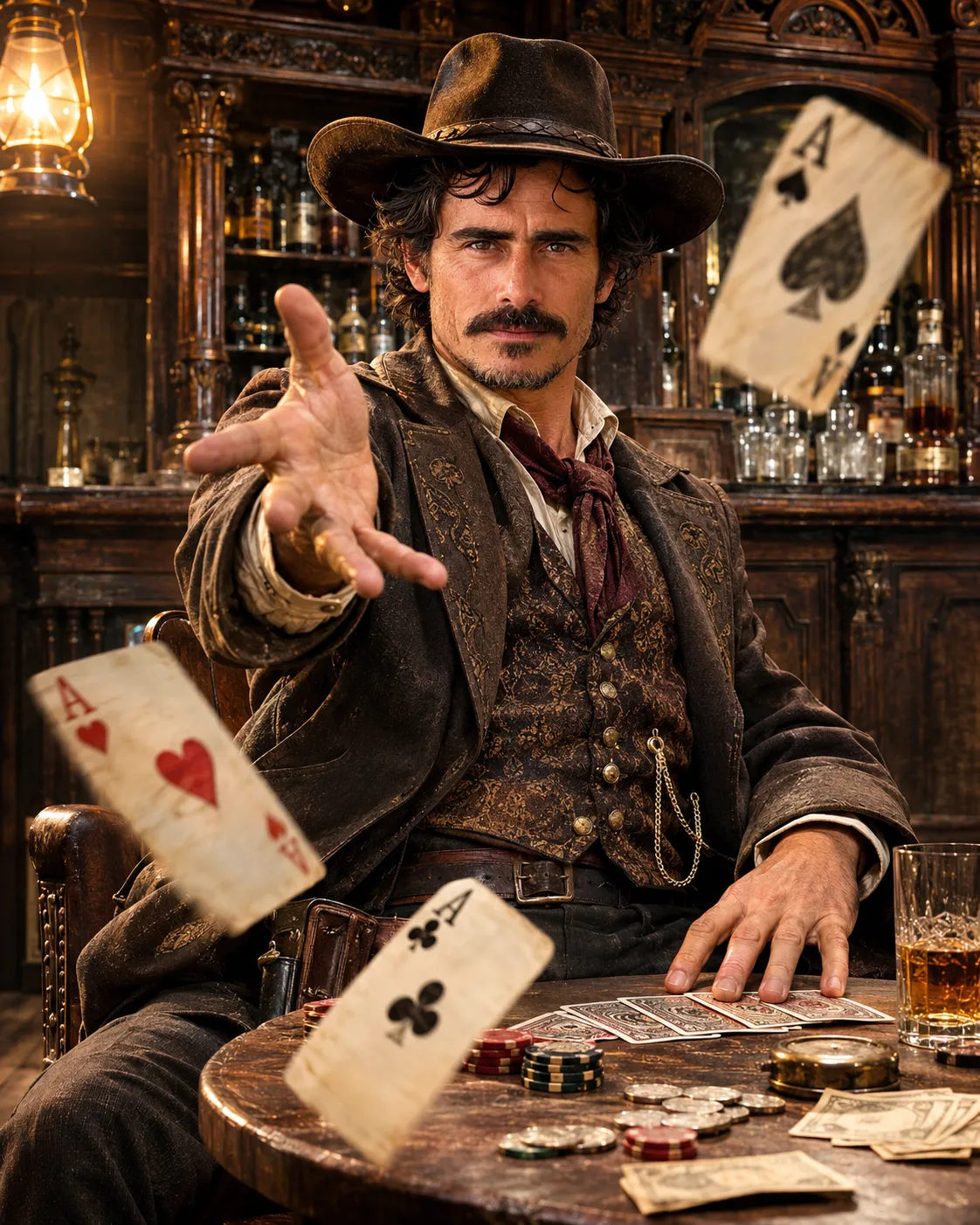
Recreate a dramatic Western gambling scene photographed from a slightly low, eye-level frontal perspective. The subject sits centrally behind a small, round, dark wooden poker table, occupying the middle of the composition. Their upper body leans slightly forward, with one arm extended dramatically toward the camera, palm open and fingers naturally spread, as though magically throwing playing cards into the air. The opposite hand rests near a spread of cards on the tabletop.

Their expression is serious, confident, mysterious, and commanding, with intense eyes looking directly toward the camera. The subject's entire head and Western hat must remain fully visible, with comfortable space above the hat. Capture the figure from the hat to approximately knee level, with the poker table dominating the lower foreground.

WARDROBE AND STYLING:

Dress the subject in historically inspired Old West gambling attire: a weathered dark brown or charcoal Western frock coat, richly textured brocade waistcoat, high-collared cream shirt, loosely tied neckerchief, antique pocket-watch chain, and a broad-brimmed dark leather or felt cowboy hat. Include subtle embroidered detailing, natural fabric creases, aged leather textures, and authentic period accessories. Clothing should appear realistically worn rather than theatrical or costume-like.

FLYING PLAYING CARDS:

Exactly THREE oversized playing cards are suspended dramatically in midair, all clearly identifiable as aces: the Ace of Spades, the Ace of Hearts, and the Ace of Clubs.

Position one ace prominently in the upper-right foreground near the subject's hat, another in the lower-left foreground beside the table, and the third floating diagonally above the front edge of the table. Each card follows a different natural tumbling trajectory, creating the illusion of an extraordinary card throw frozen at its peak.

Show recognizable suit symbols, realistic card proportions, slightly aged ivory card stock, and detailed printed designs. Apply subtle directional motion blur to the flying cards while keeping their ace identities recognizable. Avoid additional airborne cards.

POKER TABLE AND PROPS:

The circular wooden poker table fills much of the lower portion of the frame. Scatter realistic antique poker chips, silver coins, face-down and face-up playing cards, and small stacks of worn currency across its richly textured surface. Arrange a curved fan of playing cards near the subject's resting hand. Include fine wood grain, scratches, faded varnish, and natural contact shadows. Maintain accurate hand anatomy, finger placement, card perspective, and physical proportions.

BACKGROUND AND ENVIRONMENT:

Behind the subject stands an elaborate antique wooden saloon bar with ornate carved trim, decorative columns, mirrored shelves, vintage whiskey bottles, glass decanters, and period drinking glasses. The bar spans the entire background, creating architectural symmetry and a rich sense of historical atmosphere.

Include weathered timber walls, intricately carved woodwork, antique brass accents, dusty floorboards, and subtle reflections in aged glass bottles. The environment should feel authentic, richly detailed, and cinematic, resembling an expensive Hollywood Western production.

LIGHTING AND COLOR:

Render the entire scene in beautiful, natural cinematic COLOR, not sepia or monochrome. Use rich walnut browns, warm amber highlights, deep burgundy undertones, muted olive tones, aged brass, cream fabric, and natural skin colors.

Illuminate the subject with warm, directional tungsten lantern light from the upper-left side, producing sculpted facial highlights, soft golden reflections across the nose and cheekbones, and deep atmospheric shadows beneath the hat brim. Add subtle warm rim lighting along the shoulders and hat to separate the figure from the darker saloon interior.

Create dramatic chiaroscuro lighting, realistic shadow falloff, gentle atmospheric haze, subtle dust particles, and a moody, mysterious Old West ambiance. Preserve natural skin tones rather than applying an overwhelming brown color filter.

CAMERA AND PHOTOGRAPHIC SETTINGS:

Photograph with a professional full-frame camera and a 35mm cinematic portrait lens, approximately f/2.8, ISO 800, and 1/1000-second shutter speed to capture the dramatic throwing gesture. Position the camera approximately at seated chest height, looking slightly upward toward the subject.

Use a moderately wide environmental portrait perspective, with the subject's eyes and extended hand sharply rendered, subtle foreground depth separation, and softly blurred but recognizable saloon details. Maintain natural perspective distortion, realistic spatial relationships, smooth background bokeh, cinematic contrast, and subtle organic film grain.

IMAGE QUALITY:

Deliver exceptional photorealism with lifelike skin pores, individual facial hairs, realistic eye reflections, detailed hands, authentic fabric fibers, aged leather surfaces, natural wood textures, accurate playing-card designs, and physically believable lighting. Create the atmosphere of a dramatic Western film poster without adding titles, typography, watermarks, logos, borders, or modern objects.

-- ar 4:5

Vertical portrait composition, full frame height emphasis, cinematic poster layout.
What you'll create
A reference-guided gambler extends an open hand across a small wooden table. Period clothing, a broad hat and tumbling ivory cards create a dramatic frontal scene with realistic worn textures.
Usage instructions
Provide the reference photograph whose subject should appear in the scene; the prompt uses it to preserve the person’s recognizable features while placing them in the saloon setting. The three specified aces and their positions establish the central action and composition. To adjust the framing, change the requested 4:5 portrait ratio while keeping the subject’s hat and poker table within the frame.
Frequently asked questions
Which aces appear?
Spades, hearts and clubs; no diamond ace is included.
Should the cards all fly along one identical path?
No. Distinct tumbling trajectories create the frozen throw effect.



Comments
Tried this prompt? Share what you made, compare results, or ask a question