Y2K Japanese Motor-Rider Portrait with a CRT TV Pyramid
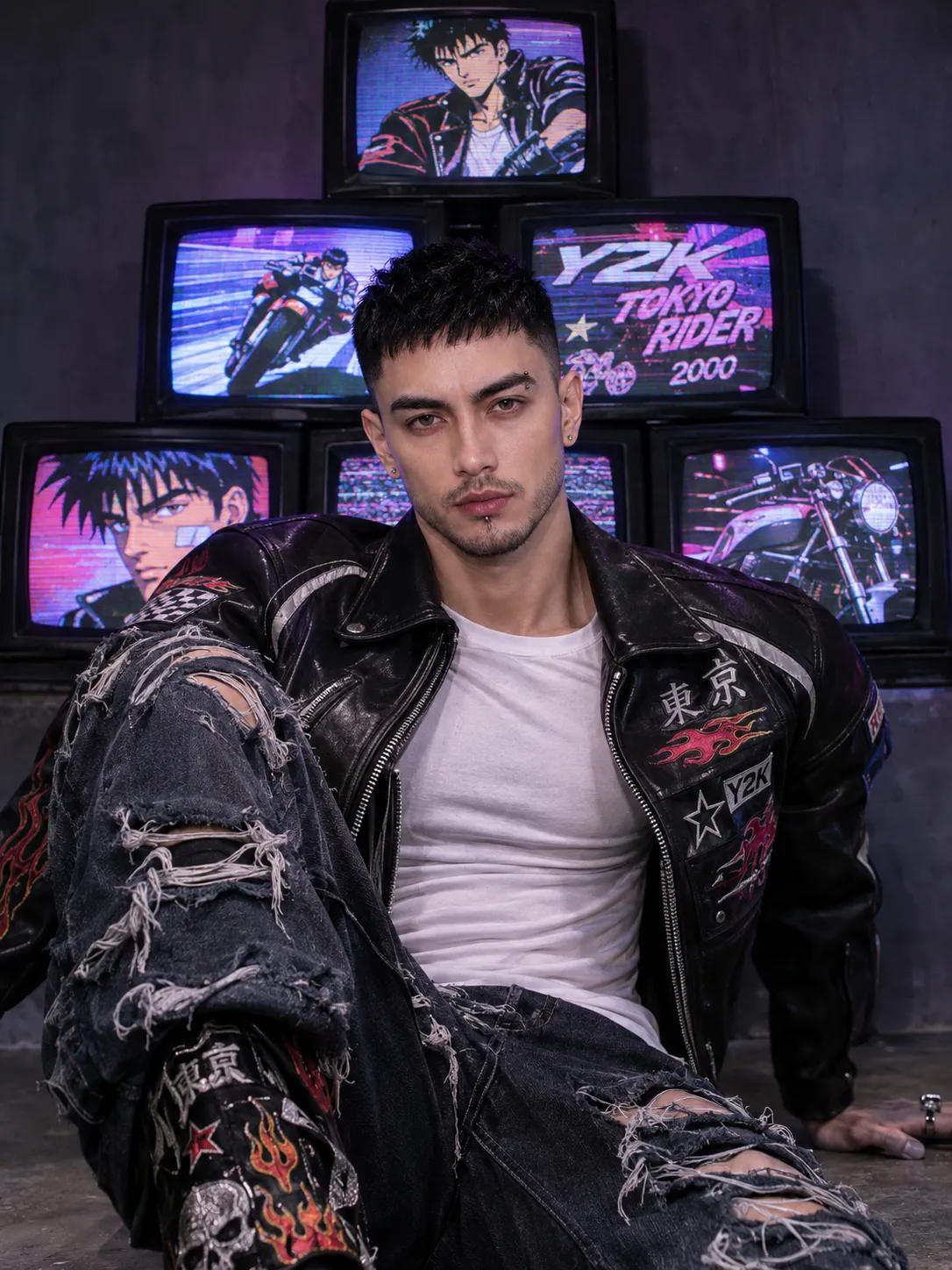
Create a close, photorealistic Y2K Japanese street-editorial portrait of a muscular man in motor-rider gear, seated before a pyramid of CRT televisions
Example outputs
Prompt template
- Format
- Text
- Inputs
- Reference_photo (image) · Required
- Outputs
- Generated_portrait (image)
Create a photorealistic Y2K Japanese street-editorial portrait with the following requirements.

SUBJECT AND IDENTITY
Show one young Indonesian man, the same man from the attached couple reference photo. Keep his face identity 100% identical to the reference: do not change his face shape, eyes, nose, lips, or facial structure. Preserve his original skin tone exactly; do not whiten, lighten, or add a tan. Give him a more muscular, athletic badboy build, especially broad, massive shoulders, thick deltoids, large biceps and forearms, and a muscular chest. He must not look slim, skinny, childish, or cute. Keep the muscles natural rather than AI-perfect or shredded, and avoid plastic-looking skin.

OUTFIT
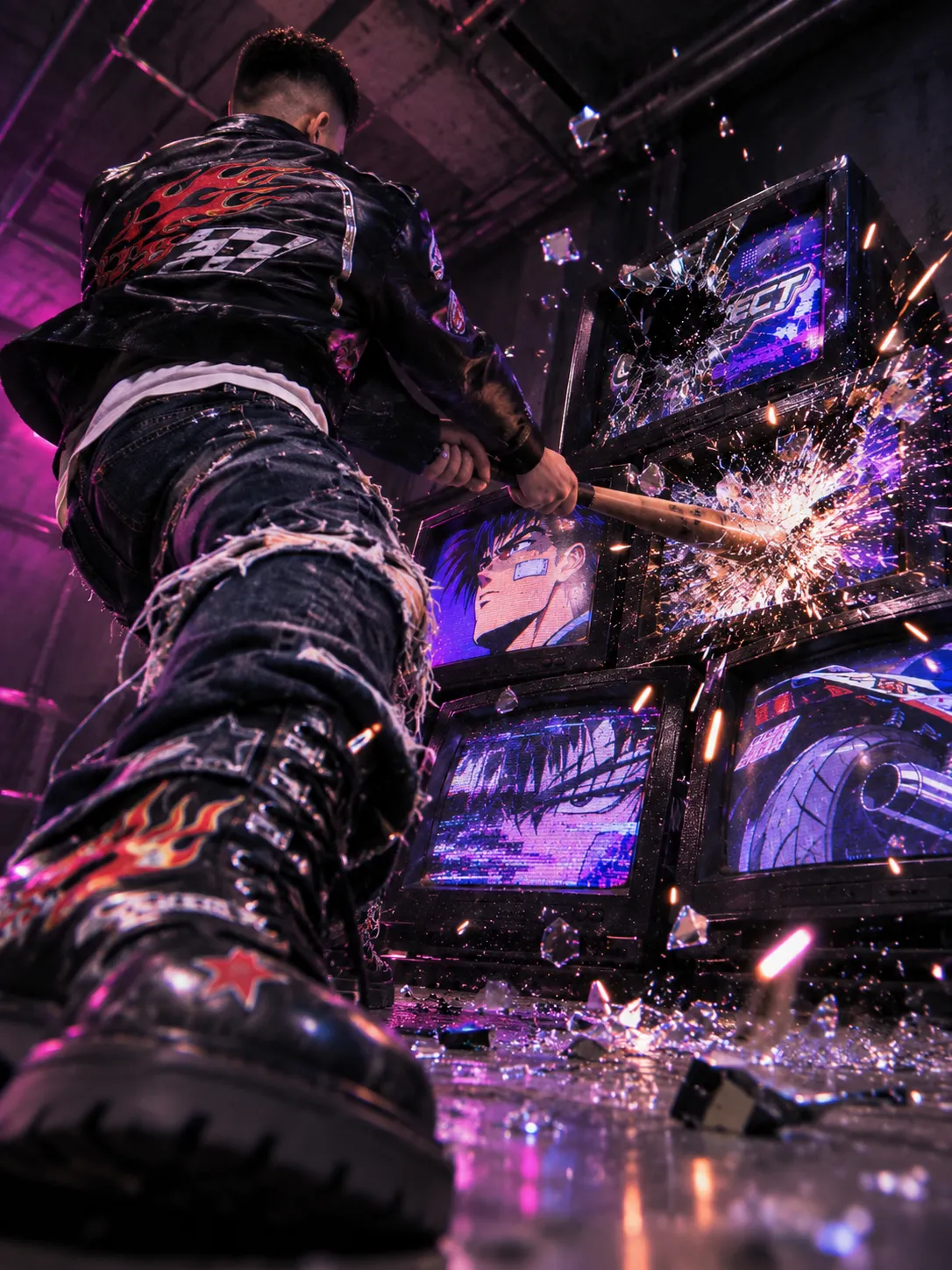
Dress him in a rugged Y2K Japanese street-style motor-rider outfit. He wears a fitted, slightly cropped black faux-leather motorcycle jacket with a front zipper, silver zippers, patches, Y2K graphics, small embroidered flames, and Japanese kanji patches on the sleeves. The collar is popped, and the jacket has wide, structured shoulders that stretch over his broad shoulders and muscular arms. Give it a worn look. Under the jacket, he wears a fitted, plain white T-shirt with no text, graphics, or print.

He wears dark-wash or faded black-blue denim jeans, baggy with a straight Y2K fit and heavily ripped all over, including the knees, thighs, and calves, with frayed edges. Do not make the jeans clean or skinny. His chunky black leather platform boots have thick soles, laces, and many colorful embroidered patches, including flames, skulls, Japanese kanji, and Y2K stars. Do not make the boots plain.

Keep his neck bare: no choker, necklace, or pendant. The only jewelry is silver rings on his fingers.

HAIR AND MAKEUP
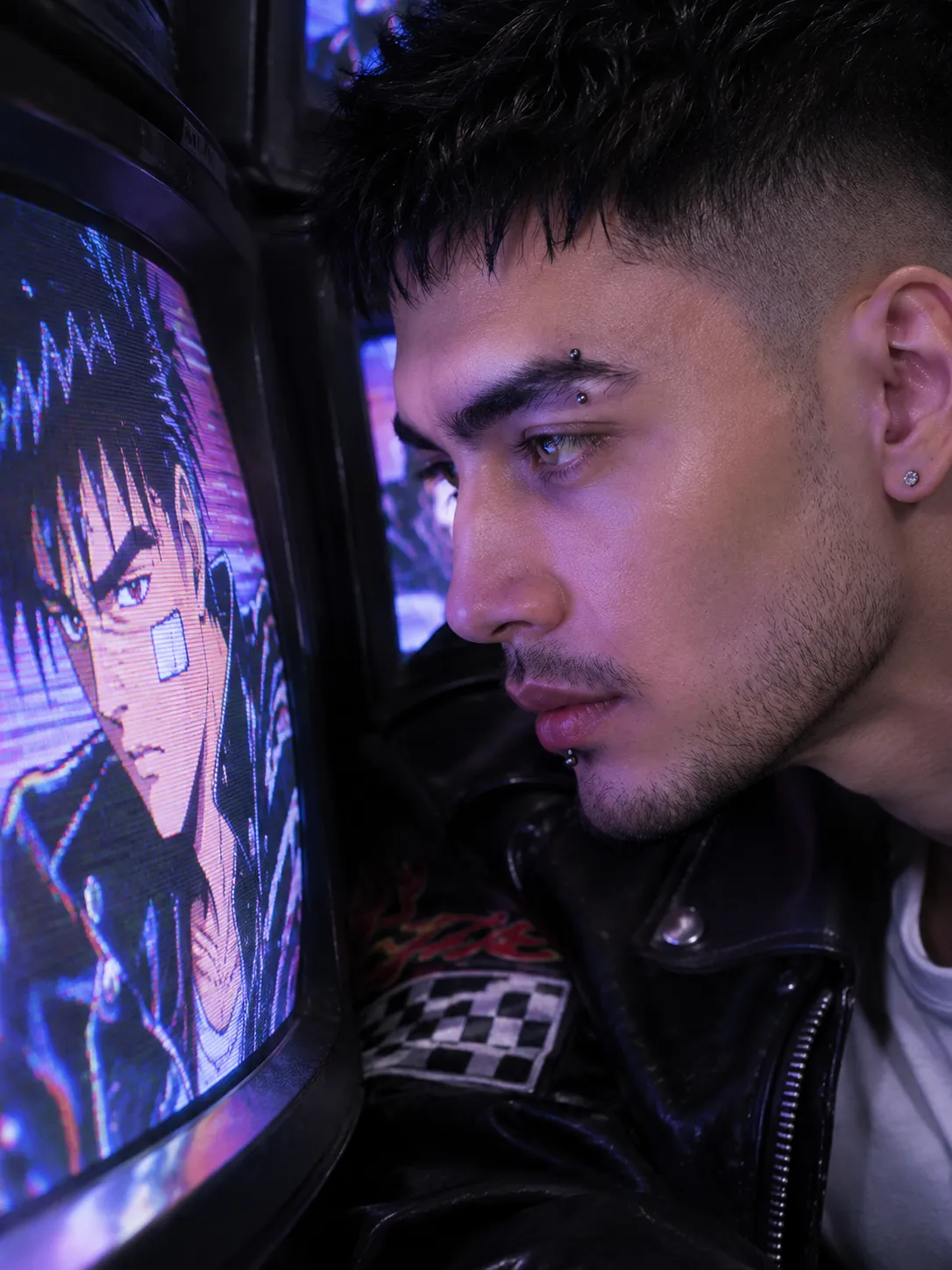
Give him short, black hair with natural volume, slightly tousled on top and clean, short tapered sides. His straight, blunt bangs sit just above his eyebrows. Do not use a side part, slicked-back hair, or long hair.

Use subtle masculine makeup: even, dewy skin; natural slight contour; soft highlights on the nose and cheekbones; thick, defined masculine eyebrows; and thin, soft black eyeliner with natural lashes. His lips are natural and masculine, matching his skin tone, with a slightly dry texture. No red tint, red lipstick, glossy finish, or juicy-looking lips.

Add a clearly visible small silver labret stud or ball at the center of his lower lip. It must be on the lower lip only, not the upper lip or nose.

EXPRESSION AND POSE
Give him an intense, confident, cold stare directly at the camera, with open, normally shaped eyes, a slight arrogant smirk, chin slightly lifted, and jaw slightly clenched. His expression should feel unbothered and masculine, not cute, childish, soft, or smiling.

He is sitting on a concrete floor, following the reference pose but with a more masculine, athletic presence. One knee is bent high in front of him, the other leg is folded to the side, and one hand rests on the floor behind his body for support while the other rests on the floor to his side. He leans back slightly with his chest up and shoulders wide, showing his muscular arms. His legs are open in a masculine pose, and his torso is slightly twisted. Keep the pose candid and dominant, not stiff or cute. Do not make him stand.

FRAMING AND COMPOSITION
Use a close, vertical 3:4 composition, framed from chest-up to waist-up, tighter than a full-body shot. Make the subject large in the frame, with a prominent head, face as the focal point, and shoulders filling the width. Keep the upper body dominant and centered, with the head in the upper center. The seated pose should still be apparent, but the crop may cut off the boots at the bottom edge. Focus on the face, broad shoulders, arms, jacket, and lower-lip piercing. Do not use a wide or full-body framing.

BACKGROUND
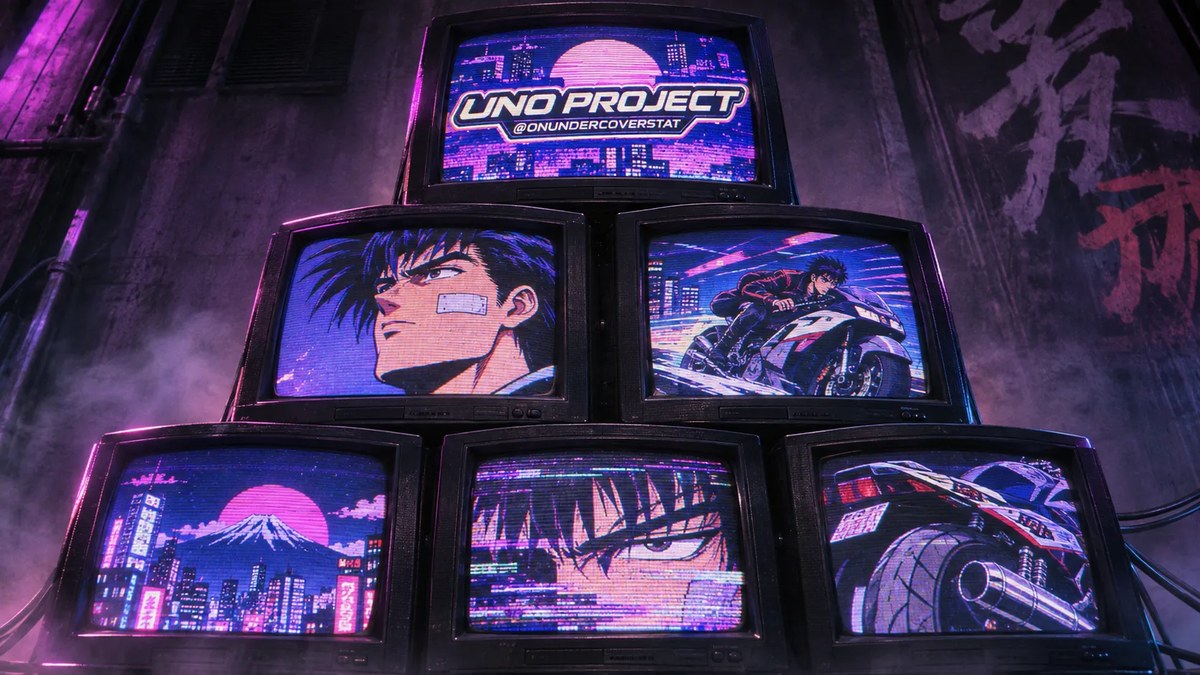
Behind him, arrange six old CRT televisions in a symmetrical pyramid: three TVs on the bottom row, two in the middle, and one on top. Every TV must have the same black plastic frame, with identical style and thickness; do not mix frame colors or designs.

Each screen shows different content:
- TV 1: A 1990s anime-style cartoon version of the man, wearing the same outfit and in the same pose, with cel shading, bold lines, and a badboy look
- TV 2: A 1990s anime motorbike-rider scene, with a rider speeding and motion lines
- TV 3: A random 1990s-style anime cartoon character with VHS grain
- TV 4: A close-up photograph of a real Y2K motorbike
- TV 5: Random Y2K writing and graffiti, including “Y2K,” “TOKYO,” “RIDER,” and “2000,” with pixel fonts, chrome text, and random stickers
- TV 6: Random 1990s anime imagery with glitch, static, and VHS noise

Give all screens VHS grain, scanlines, slight glitch, and vibrant purple, blue, pink, and white colors. The background wall is dark gray, and the floor is dark concrete. The TVs are the only light source besides the key light.

CAMERA AND LIGHTING
Use a Sony A7IV with a 50mm f/1.4 GM lens, f/2.0 aperture, ISO 400, and a low-light editorial raw-photo look. Keep the face, broad shoulders, and lip piercing tack-sharp. The background TVs are slightly blurred, but their content remains readable. Do not use a beauty filter, face smoothing, or body reshaping; retain realistic skin texture.

Use low-light indoor illumination with a soft key light on the face from the front. Blue, purple, and pink light from the TV screens falls across the face and body, with rim light from the TVs behind him. Keep the shadows deep. No daylight, harsh flash, or bright studio lighting. TV glow creates colorful reflections on the leather jacket, boots, and metal lip piercing.

VISUAL STYLE AND COLOR
Use a photorealistic, cinematic Y2K Japanese street-editorial look, with realistic skin, leather, heavily ripped and frayed denim, embroidered boots, and CRT-TV textures. Include scanlines and subtle film grain. Avoid an AI-perfect appearance, plastic skin, or excessive editing.

Use a dark, moody palette: warm skin tones contrast with blue, purple, and pink TV glow; the black leather is deep, the ripped jeans are faded blue-black, and the colorful boot embroidery stands out. Keep the TVs vibrant, blacks slightly lifted, contrast high, and highlights clean. Avoid oversaturation, HDR halos, and whitening filters.

Do not change the man’s face or skin tone. Do not replace the motor-rider outfit with a schoolgirl outfit, blazer, tie, skirt, or thigh-high socks. Keep the white undershirt plain and text-free, the jeans heavily ripped all over, and the boots covered with embroidery. Keep the short, slightly tousled hair with straight bangs above the eyebrows; do not make it long, side-parted, or slicked back. Keep the makeup masculine and subtle, the lips natural rather than red or glossy, and the silver labret at the center of the lower lip. Keep the cold, masculine badboy expression and seated pose with one knee raised and hands on the floor. Keep the close waist-up composition, the symmetrical 3-2-1 CRT pyramid with identical black frames, and the bare neck without a choker or necklace. Keep his body muscular, especially the shoulders and arms.
What you'll create
This prompt creates a close, photorealistic Y2K Japanese street-editorial portrait of a muscular young Indonesian man seated in a badboy pose. A pyramid of CRT TVs, moody colored screen light, and detailed motor-rider clothing define the composition
Usage instructions
Attach the reference photo of the man; the prompt uses it for his identity, skin tone, and seated pose. The framing is intentionally close, so adjust the waist-up composition only if you want to change the stated emphasis on his face, shoulders, arms, and piercing
Frequently asked questions
What does the reference photo determine?
It is used to match the man’s face and skin tone and to guide the seated pose




Comments
Tried this prompt? Share what you made, compare results, or ask a question