Bharatanatyam Fashion Editorial with Flying Versace Drapery
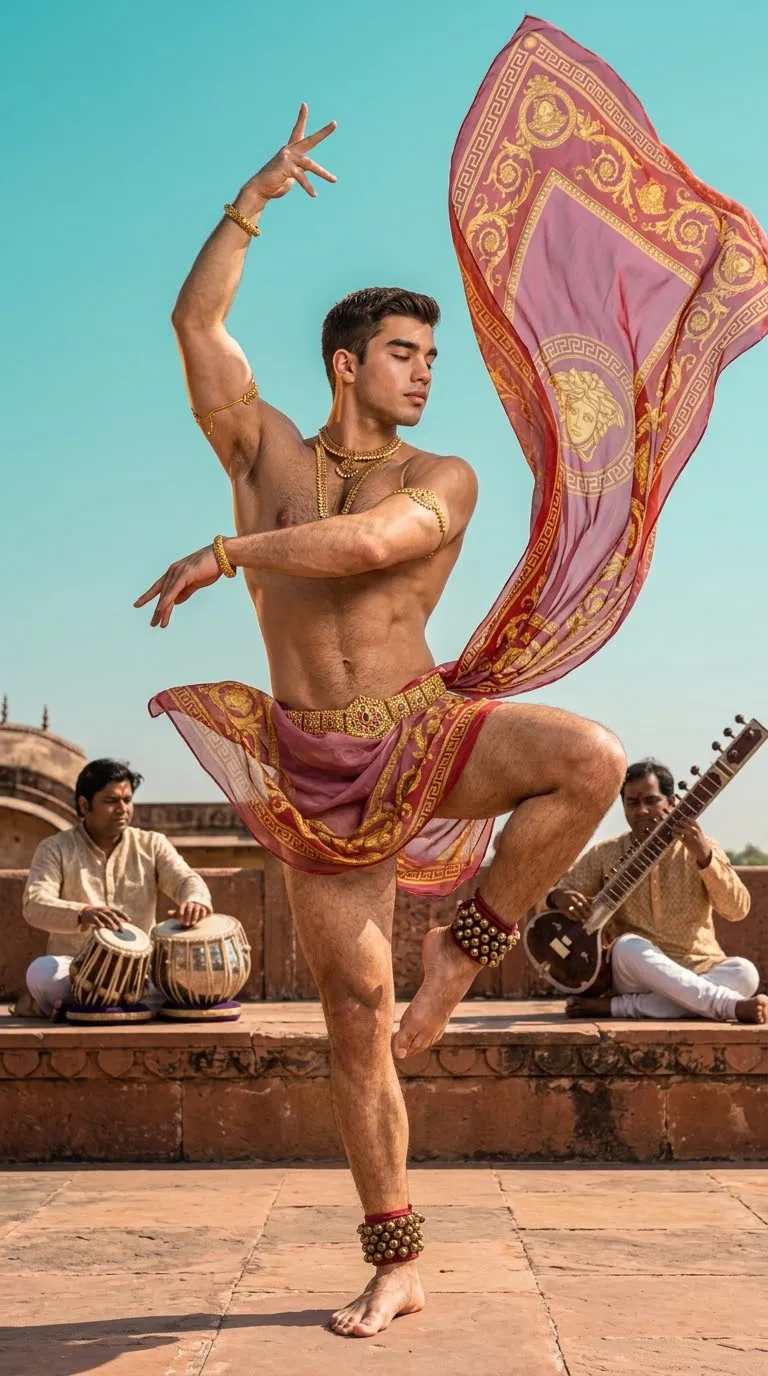
Create a full-body, photorealistic fashion editorial portrait of an Indonesian-Dutch man dancing Bharatanatyam on a temple terrace, with musicians behind him and patterned silk drapery billowing overhead.
Example outputs
Prompt template
- Format
- Text
- Inputs
- Reference_photo (image) · Required
- Outputs
- Fashion_editorial_portrait (image)
Create a cinematic, high-fashion fitness photograph in a full-body vertical portrait composition, 9:16 aspect ratio, with an eye-level camera, 50 mm lens, and f/2.8. Aim for crisp, pin-sharp detail, realistic skin texture, vivid cinematic color grading, and the quality of a luxury fashion editorial.

Use the attached photo as the reference for the subject's appearance. Depict him as an Indonesian-Dutch man, not an Indian man, preserving the reference subject's ethnicity and appearance. He is a handsome, athletic, highly muscular man, about 190 cm tall, with broad shoulders, defined arms, large thighs and legs, firm glutes, and proportional anatomy. Give him short hair in a dark ash-brown/blonde tone, warm pale skin, a straight nose, thick arched brows, hazel eyes, and subtle body hair. Keep his bare chest exposed.

Show him performing a dynamic Bharatanatyam dance pose on an Indian temple terrace. He balances on his straight, strong right leg, foot flat on the stone floor, while his left leg is lifted high and bent at the knee, with pointed toes in a Nataraja-style pose. Both arms are raised overhead with slightly bent elbows; his hands form elegant Bharatanatyam mudras with curved fingers and forward-facing palms. Tilt his head slightly to the side, eyes closed, with a serene expression and soft smile. Turn his body 45 degrees away from the camera rather than facing it directly, while turning his head slightly toward the camera.

He is shirtless, with no shirt, jacket, or dress. Do not dress him in a dhoti. Wrap a long, thin, light, sheer silk-chiffon or organza drape around his waist to cover his hips and upper thighs. Give it elegant folds and a deep mauve-pink and scarlet-red palette with a luxurious Versace-inspired pattern of gold Medusa heads, Greek-key borders, baroque scrolls, and chain motifs. The long end of the drape must remain visibly attached at his waist and fly high above his head to the right, caught by the wind like a giant, thin silk wave. Show its shiny fabric, folds, and gold pattern clearly. Its movement must flow strongly upward in a dynamic spiral, rising with the energy of his dance—not hanging, falling, lying flat, or moving downward.

Put traditional Indian ghungroo—strings of small brass bells tied with red and gold threads—around both ankles, clearly visible on the lifted left ankle and standing right ankle. Add intricate gold temple jewelry: necklaces, armlets (Vanki), and waist belts (Oddiyanam) set with red and green kemp stones, plus gold bracelets on both wrists.

Set the scene on an old Indian stone temple terrace with a weathered stone floor and pillars. Place two slightly out-of-focus Indian musicians directly behind the dancer, not beside him: a tabla player behind his left shoulder, hands on the drums, and a sitar player behind his right shoulder, fingers on the strings. Both musicians look toward the dancer. Do not leave the background empty or place musicians at either side.

Use bright midday sunlight to illuminate the subject and outfit, reveal the definition of his muscles with soft shadows, and avoid harsh lighting. Give the sky a teal tone with subtle clouds; use orange tones on the temple, floor, and horizon, with a subtle, soft golden-orange backlight on the edges of his hair, shoulders, and torso. Avoid a harsh outline rim or glowing effects. Let the drapery show realistic, shiny silk reflections.

Use a palette of scarlet-red silk, gold patterning, warm pale skin, and ash-brown/blonde hair. Render realistic skin and extremely detailed, light, sheer chiffon folds. Keep the full figure visible from head to feet, including both arms, with the dancer centered and grounded on the floor. Make the lifted leg and flying drapery prominent and visible in the frame, with balanced negative space and no excess space above the subject.

The result must look like a photorealistic high-end editorial photograph, not an illustration, painting, cartoon, or 3D render. Avoid a CGI or artificial-looking result, extra limbs, phantom hands, blur, large dark moles, and modern stage or studio settings. Do not include a watermark or signature text.
What you'll create
An athletic reference-based man performs a full-body dance pose with flying Versace fabric. Eye-level photographic framing and vivid cinematic color emphasize movement within a traditional temple environment.
Usage instructions
Provide the reference photo for the depicted man's appearance. The pose, drapery movement, and placement of the musicians are central to the composition; the specified vertical 9:16 framing is intended to include the dancer from head to feet and the flying fabric.
Frequently asked questions
Does the costume change the subject into an Indian person?
No. His Indonesian-Dutch ethnicity is preserved.
Should the background become a modern stage?
No. Modern stage and studio settings are excluded.




Comments
Tried this prompt? Share what you made, compare results, or ask a question