Futuristic Winter Fashion Triptych Editorial
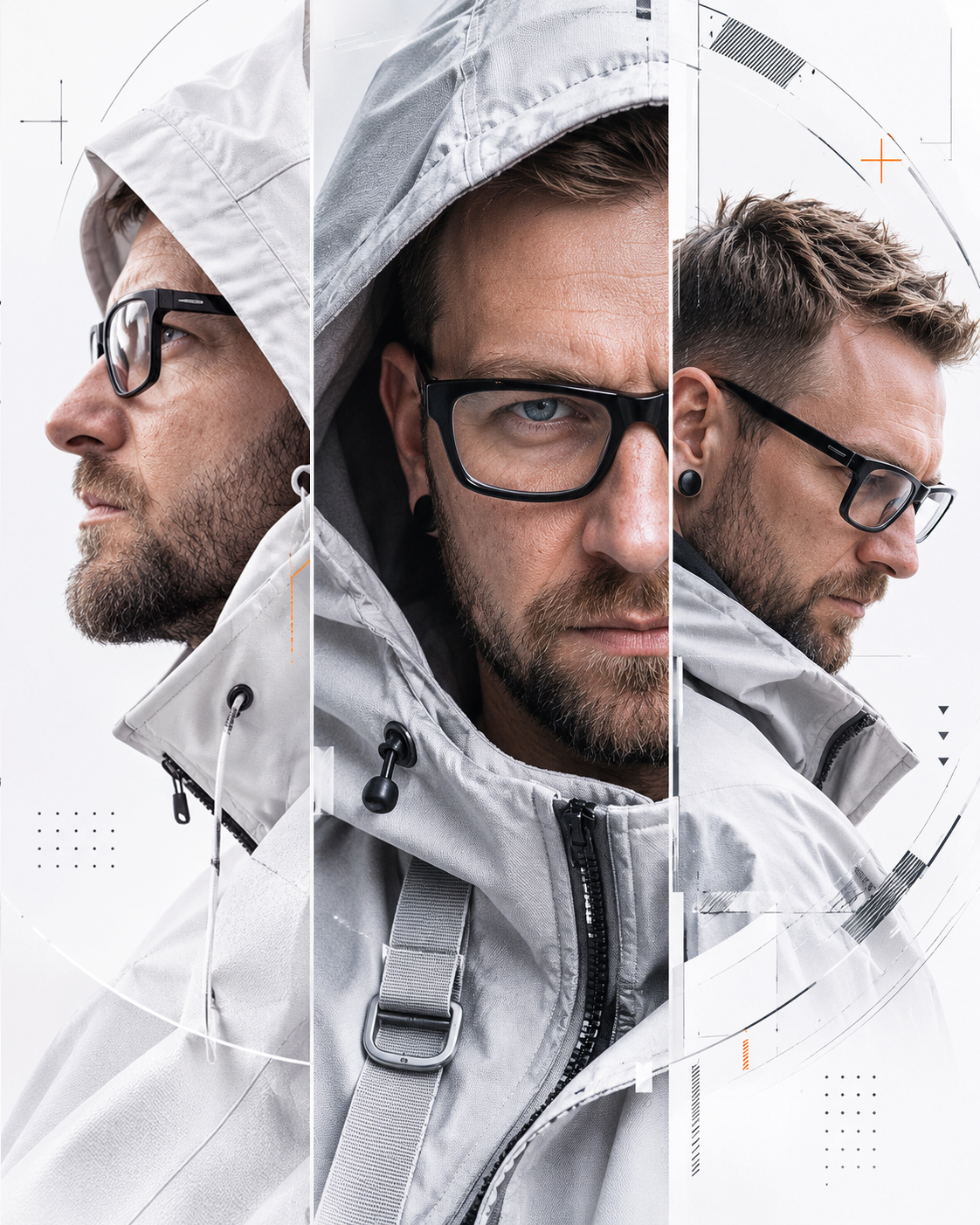
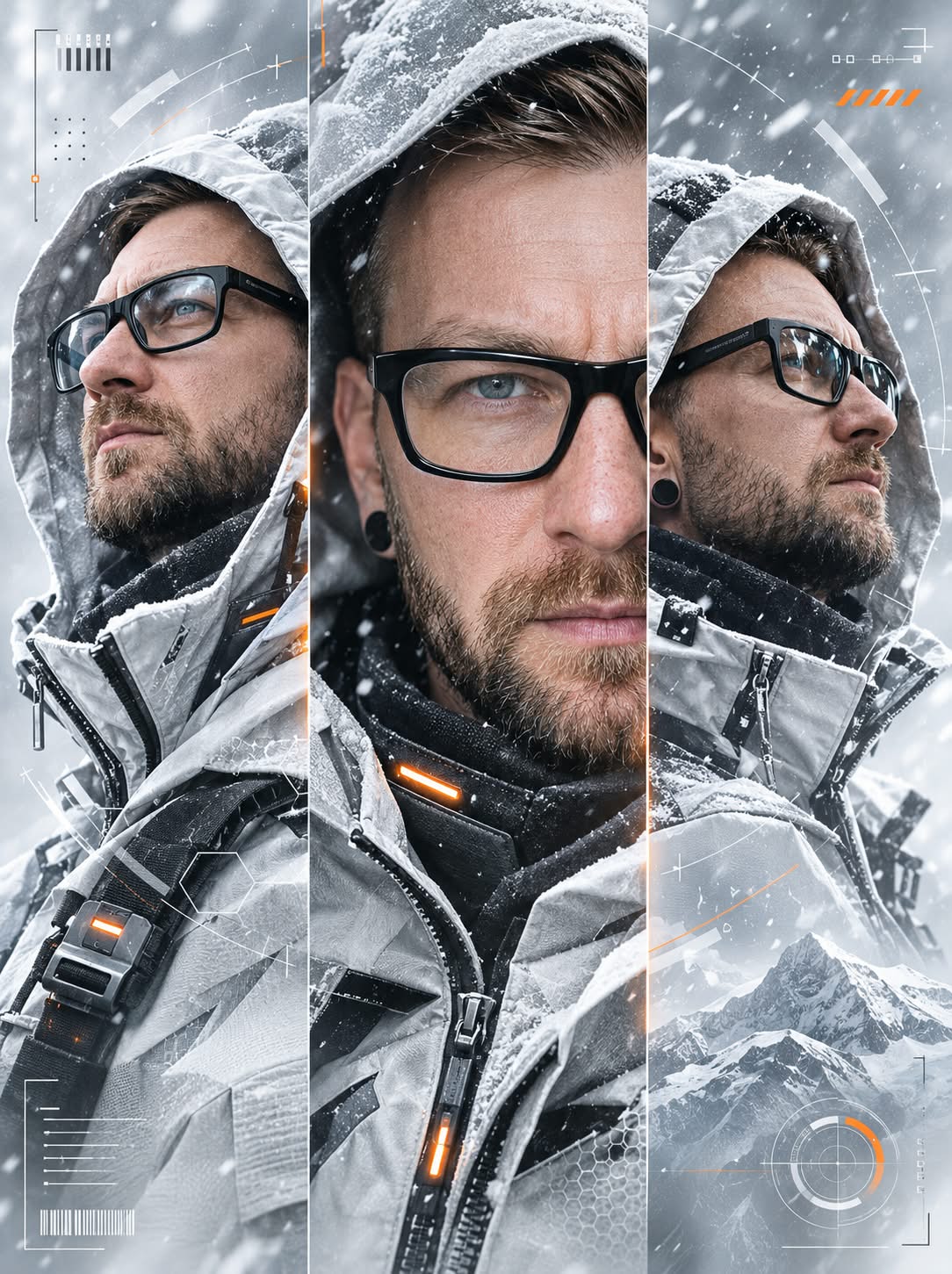
Create a photorealistic winter fashion portrait as an asymmetric triptych, with consistent identity across three views and restrained technical graphics.
Example outputs
Prompt template
- Format
- Text
- Inputs
- Reference_photographs (image) · Required
- Outputs
- Photographic_editorial_image (image)
Create an ultra-photorealistic futuristic winter fashion editorial in an experimental Swiss photographic triptych style, with a minimalist cybernetic infographic aesthetic and a vertical 4:5 composition.

IDENTITY AND FACIAL ACCURACY
Use the uploaded reference photographs as the primary identity source. Recreate the exact same person across all three photographic fragments, preserving authentic facial anatomy, natural proportions, eye shape and color, nose structure, jawline, cheekbones, lips, hairline, hairstyle, beard density, facial asymmetry, and distinctive individual features.

Keep the subject instantly recognizable from every viewing angle. Preserve natural age, real skin imperfections, fine wrinkles, individual beard fibers, and subtle facial texture. Do not beautify, reconstruct the face, impose artificial symmetry, or idealize features.

TRIPTYCH COMPOSITION
Arrange three sharply cropped vertical photographic fragments at subtly staggered heights. They should form one unified conceptual portrait, not three independent photographs.

LEFT FRAGMENT: Show a tight left-facing side profile with a slightly raised chin and a thoughtful, confident expression. Preserve the natural anatomical silhouette of the forehead, nose, lips, and beard. Frame the head with a white technical hood and add black rectangular eyeglasses with completely transparent lenses.

CENTER FRAGMENT: Make this the dominant, extreme close-up frontal portrait, with intense direct eye contact and a serious, composed expression. Use a very tight geometric crop extending from the forehead through the beard. Let the vertical cut intersect the outer cheek and facial contour, revealing a large recognizable portion of the face rather than a complete conventional headshot. Keep at least one eye fully visible and sharply focused. Make the center fragment slightly narrower than the surrounding visual areas for a sophisticated, asymmetric editorial rhythm.

RIGHT FRAGMENT: Show a close-up three-quarter side portrait, with the head slightly lowered and the gaze directed downward. Make the natural short textured hairstyle visible. Keep the glasses, beard structure, and facial identity consistent. Show the same technical jacket, with the hood resting naturally behind the neck.

Maintain perfect identity consistency, realistic anatomical continuity, identical eyeglass design, and consistent wardrobe across all three fragments.

FUTURISTIC WARDROBE
Dress the subject in luxury contemporary winter techwear in monochromatic porcelain white, soft silver, and pale cool gray.

Use an architectural oversized technical parka with a structured high collar, naturally draped hood, waterproof multilayer textile, precision-engineered seams, subtle ripstop fabric texture, technical zippers, matte-black drawstring hardware, woven straps, metallic buckles, and refined functional construction. Use subtle futuristic tailoring and sophisticated wearable technology, without exaggerated armor, robotic body parts, or science-fiction costumes.

Show the same jacket in every fragment. Raise the hood naturally in the left and center views and lower it in the right view. Render realistic fabric weight, folds, tension, stitching, and construction.

EYEGLASSES
Use bold black rectangular optical frames with identical proportions and shape in all three portraits. The lenses must be completely clear, colorless, and transparent, revealing the natural eyes. Include subtle, physically accurate glass reflections, controlled optical distortion, realistic frame thickness, and perfectly aligned temples. Let the black glasses provide a strong graphic accent against the predominantly white composition.

Do not use sunglasses, dark lenses, mirrored surfaces, or concealed eyes.

CYBERNETIC INFOGRAPHICS
Integrate sophisticated futuristic technical infographic elements directly into the photographic composition. Use ultra-thin geometric arcs, incomplete circular interface diagrams, delicate calibration lines, precision crosshairs, micro-grid coordinates, dotted matrices, small barcode-inspired graphic accents, architectural measurement ticks, subtle data visualization marks, and flowing technical curves. Add extremely restrained fluorescent orange micro-accents at selected intersection points and interface markers.

Make the infographics feel like an experimental Swiss graphic designer’s precision-engineered visual system, not a gaming interface. Use clean vector-like geometry, carefully balanced visual hierarchy, subtle overlaps, and intentional negative space. Keep graphic elements secondary to the photographic portraits; they must not cover important facial details.

ENVIRONMENT AND COLOR HARMONY
Use a seamless high-key white studio environment with an extremely subtle cold winter atmosphere. Keep the palette unified: pure white, porcelain, frost gray, pale silver, muted cool charcoal, and deep black, complemented by tiny restrained orange accents.

Include minimal atmospheric frost, a few delicate airborne snow crystals, and subtle winter haze. Avoid heavy snowfall and distracting environmental scenery. Ensure all three fragments share consistent white balance, exposure, shadow temperature, contrast, skin tones, and photographic grain.

Use a clean luminous background with no separate environments inside the fragments, distracting objects, borders, frames, or panel shadows.

CAMERA AND PROFESSIONAL LIGHTING
Use premium medium-format editorial photography with a Hasselblad X2D 100C aesthetic, an 80mm portrait lens, f/5.6, ISO 100, natural optical perspective, and high-resolution photographic realism.

Use a large diffused frontal key light, soft overhead illumination, subtle cool ambient fill, delicate edge separation, controlled specular highlights, and naturally graduated shadows. Preserve realistic skin luminosity without flattening facial structure. Retain detailed highlights in white fabrics, natural shadow depth beneath the hood, and realistic reflections in the eyeglasses.

Use precise facial focus, authentic optical detail, sophisticated tonal separation, realistic material response, and gentle cinematic depth. Aim for professional fashion campaign lighting without harsh artificial HDR effects.

TEXTURE AND PHOTOGRAPHIC REALISM
Render authentic detail: visible skin pores, fine facial hair, realistic beard strands, subtle imperfections, natural eye moisture, optical glass reflections, micro-textured technical fabrics, fine stitching, woven fibers, brushed metal components, and tiny frost particles.

Use organic photographic texture, restrained fine-grain film character, natural microcontrast, physically plausible highlights, and delicate tonal transitions. Keep detail high without excessive sharpening, artificial clarity, plastic skin, or overprocessed textures.

FINAL ART DIRECTION
Combine avant-garde fashion photography, experimental Swiss editorial design, minimalist futuristic technology, and cold architectural aesthetics. Show three fragmented views of one recognizable human identity, united by precise geometry, professional photographic lighting, sophisticated white technical clothing, and understated cybernetic infographic details. Aim for museum-quality art direction, a premium luxury fashion editorial, sophisticated negative space, immaculate composition, and genuine photographic realism.

STRICT NEGATIVE CONSTRAINTS
No identity drift, different faces, inconsistent glasses, tinted lenses, exaggerated or cone-shaped hoods, inconsistent jackets, robotic faces, cybernetic implants, armor, helmets, fantasy characters, heavy snowstorms, industrial backgrounds, excessive orange lighting, neon cyberpunk city, grunge, dirt, excessive infographic clutter, artificial HDR, oversharpening, CGI appearance, illustration, painterly effects, plastic skin, beauty retouching, separate photo panels, collage borders, large typography, logos, or watermarks.

Aspect ratio 4:5. Ultra-photorealistic photographic output.
What you'll create
Three staggered photographic fragments show the same person in pale winter techwear, moving from a raised side profile to a direct frontal gaze and a lowered three-quarter view. A high-key white studio, fine frost particles and soft controlled light keep the textures luminous, with sparse orange technical marks around the portraits.
Usage instructions
Frequently asked questions
Should the glasses have dark or mirrored lenses?
No. The black optical frames use clear, colorless lenses, keeping the natural eyes visible in every fragment.
Is the hood positioned the same way in every view?
The hood is raised in the left and center views, then rests behind the neck in the right view. The jacket itself remains consistent.
Does the winter setting call for a blizzard?
No. The atmosphere uses only a few delicate snow crystals, minimal frost and subtle haze. Heavy snowfall and distracting winter scenery are excluded.




Comments
Tried this prompt? Share what you made, compare results, or ask a question