Monochrome Wet-Weather Editorial Portrait
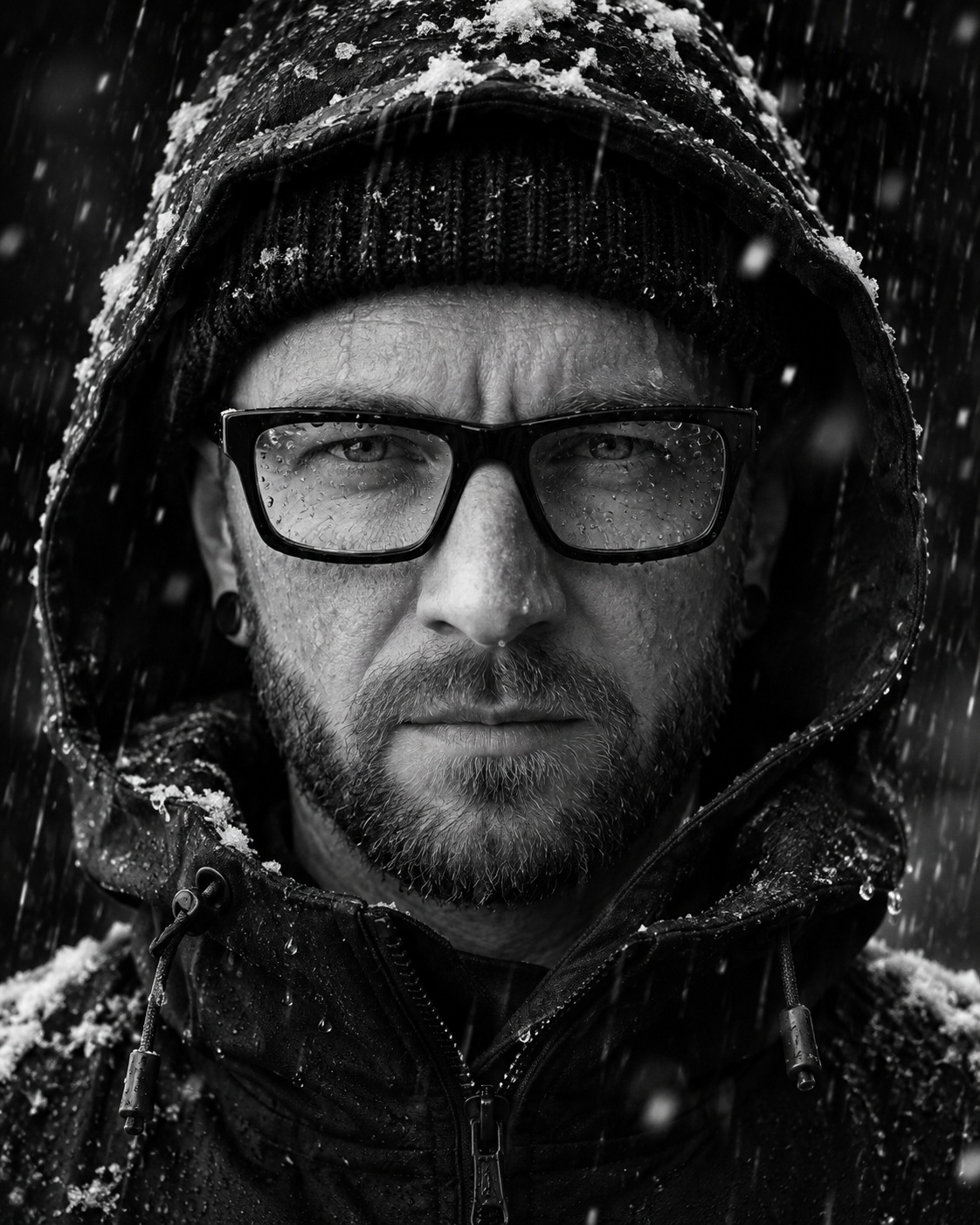
Create a tightly cropped, photorealistic black-and-white fashion portrait of the person in the reference photographs, with transparent black-framed glasses and a protective winter hood amid dramatic precipitation.
Example outputs
Prompt template
- Format
- Text Parameterized
- Inputs
- Reference_photographs (image) · Required weather_mode (text) · Required
- Outputs
- Portrait (image)
Create an ultra-photorealistic, high-contrast black-and-white cinematic fashion portrait of the exact same person shown in the uploaded reference photographs. Use a vertical 4:5 composition. The result must feel like a real premium editorial photograph captured outdoors in a harsh mixture of rain, sleet, and snow. Preserve the person's natural identity above all else.

IDENTITY — STRICT REFERENCE FIDELITY

Combine the uploaded photographs to reconstruct the subject's authentic face. Do not imitate a generic model. Faithfully preserve the individual's eye color and shape in grayscale, pupil alignment, brow structure, real nose bridge and tip, cheekbones, forehead, lips, jawline, ear placement, hairline, age, skin texture, subtle asymmetry, and recognizable beard growth.

Show black ear gauges or piercings only if they are present in the input photographs. Do not change ethnicity, facial proportions, apparent age, or expression to match a fictional character.

Keep the beard naturally full and, if needed, a little denser, but do not radically enlarge it or change the person's natural outline.

COMPOSITION & ATTITUDE

Create a single centered head-and-shoulders portrait, not a triptych or collage. Show the subject full-front, with eyes directed straight into the camera. Use strong, intimate cropping: the hood nearly touches the top and side boundaries, while the lower edge includes the structured jacket collar, upper chest, and a few folds of outerwear.

Let the face, eyeglasses, and beard dominate. Use a serious, proud, restrained expression: subtle furrowing between the eyebrows, mouth relaxed and closed, no smile, and no theatrical anger. Convey a strong masculine presence through the subject's actual facial structure, direct eye contact, and controlled lighting, never by altering identity. Maintain natural asymmetry within a carefully balanced composition.

BLACK WINTER WARDROBE

Dress the subject in a functional premium black waterproof technical jacket with a structured raised collar, realistic seams, dark hardware, zipper teeth, cord toggles, and densely woven rain-resistant fabric.

A black hoodie forms an anatomically realistic hood around the head and shoulders. The hood follows the natural dome of the skull and drapes according to gravity, with realistic folds and small fabric tension lines. Do not make it a giant pointed tent or oversized cone.

Use the selected weather mode to choose realistic headwear:
- SNOW / SLEET: A closely fitted black rib-knit winter beanie visible beneath the hood, with readable wool loops and a small amount of accumulated snow.
- RAIN / SLEET: A low-profile black baseball cap beneath the hood, with a subtle curved brim and water beading on the surface; the brim must not obstruct the eyes.

In either mode, keep the subject's authentic black rectangular optical eyeglasses, with thick, consistent frames and fully transparent, colorless lenses. Keep the eyes clearly visible through real droplets and modest reflections. Do not use opaque or tinted sunglasses or mismatched frames.

WEATHER — SELECTED VISUAL VARIATION

Use only the selected dominant weather mode. Keep the other precipitation type as a subtle secondary element. Generate one portrait only, never two portraits in one image.

SNOW / SLEET MODE:
Show a visible winter squall: large, softly blurred foreground flakes; medium-sized, sharply resolved flakes around the face; and countless finer flakes receding into the dark background. Place small crystalline snow clumps on the top of the hood, knitted beanie, shoulders, jacket seams, and beard. Show cold sleet and a few wet droplets on the optical glass, with some crystals melting into small drops. Let wind give falling snow a slightly diagonal, physically convincing direction. Snow must be clearly visible without covering the pupils, nose, or lips.

RAIN / SLEET MODE:
Show heavy cold rainfall with diagonal streaks of multiple lengths and depths, scattered wet snow grains in the distance, isolated splashes, and streams of water running down the hood. Add transparent droplets to the eyeglass lenses and top frame, nose bridge, cheeks, beard, and dark jacket. Water gathers at the edge of the cap brim and hood before falling naturally in larger drops. Some wet beard strands separate and reflect the backlight. Keep droplet surface tension, refraction, gravity, and scale believable. The eyes remain sharply legible.

In both modes, make the precipitation feel like part of a photographed environment, not a digitally sprinkled particle layer. Make the jacket respond realistically to moisture with a damp nylon sheen, droplets on seams, and subtle snow or sleet on upper surfaces.

CAMERA & OPTICS

Use premium full-frame editorial photography with a natural 35mm portrait-lens look. Keep perspective carefully controlled to avoid stretching the subject's nose or distorting the eyeglasses. Position the photographer at the subject's eye level, with the camera centered.

Shoot near f/2.8–f/4, ISO 200–400, with a sufficiently short shutter exposure to retain detailed raindrops and snow crystals while allowing some precipitation streaks. Keep the eyes and glasses critically sharp; ears and clothing may soften slightly with realistic optical depth. Use high-resolution 4K photographic character, subtle organic grain, natural lens rendering, and no fake AI sharpening.

LIGHTING — SCULPTURAL HIGH CONTRAST

Use a deep black environment and one large, soft but directional key light from a slightly elevated front-side position. Add subtle fill to reveal pores, nose, and beard structure without flattening shadows. Use a narrow white or silver rim or backlight to catch droplets along the hood and coat and separate rain or snow from the dark background. Let the dark hood interior frame the face without burying the eyes in shadow.

Use natural wet specular highlights on the optical glass, eyelashes, jacket hardware, snow clumps, and individual beard hairs. Preserve detailed facial midtones, clean luminous weather highlights, and rich textured blacks. Do not use colored rim lights, dramatic orange or blue lights, or a studio-white background.

ABSOLUTE MONOCHROME

Render in neutral 100% black and white. Use no sepia, teal, brown, warm tint, cold blue cast, colored eyes, or colored lighting. Use a wide photographic tonal range: deep neutral blacks, luminous whites, richly resolved silver grays, textured skin, and readable near-black fabrics.

The black backdrop may have subtle indistinct rain streaks and defocused texture, but no recognizable city streets, signage, or scenery.

MICRODETAIL & PHYSICAL REALISM

Show individual eyebrow hairs and beard strands, authentic damp skin pores, small fine wrinkles, subtle under-eye texture, realistic lashes, and moisture at the eyelids. Include visible ribbed-knit loops in the beanie or woven cap fibers, waterproof textile grain, stitching, zipper teeth, drawcords, metal fasteners, ice crystals, wet fabric folds, and physically refracted droplets on clear optical lenses.

Allow slight photographic imperfections and believable organic detail. Preserve real facial proportions, healthy natural skin, and human presence. Avoid waxy retouching, extreme clarity, fake HDR, exaggerated eye contrast, and CGI materials.

FINAL ART DIRECTION

Create an iconic, tightly cropped, intense black-and-white editorial portrait, close in spirit to classic dramatic wet-weather photography. Show a recognizable person with a direct gaze, protective black winter hood, signature transparent black-framed glasses, truthful skin texture, deep shadows, and unmistakable precipitation. Make it a simple, visually arresting photograph rather than a design poster. One person, one coherent frame. No typography, graphics, split panels, or extra subjects.

STRICT NEGATIVE CONSTRAINTS

Do not alter identity, age, ethnicity, nose, eye shape, glasses, or natural facial proportions. Do not show a bald head, a cap in snow mode, a knitted beanie in rain mode, a pointed or oversized hood, opaque lenses, mirrored sunglasses, an oversized fake beard, disembodied hands, robotic anatomy, extra people, a blizzard obscuring the face, water masking the eyes, giant digital snowflakes, inaccurate water physics, color grading, dramatic color accents, painting, cartoon, illustration, 3D render, plastic skin, airbrushed pores, over-sharpening, artificial HDR, logos, captions, or watermarks.

OUTPUT

Generate one photorealistic image in vertical 4:5, preserving maximum facial identity. Choose ${weather-mode} mode to vary the result while keeping the same subject, framing, glasses, wardrobe quality, monochrome treatment, and strong camera lighting.
Replace the ${…} placeholders with your values
before using this prompt. See parameters
and defaults below
Parameters
Replace each placeholder with your own value, or use its default when one is provided
${weather-mode}
weather-mode
Required
What you'll create
A reference-guided subject faces the camera in a black winter hood, with wet fabric, fine facial texture and visible precipitation defining the close crop. A soft directional key and narrow silver rim reveal droplets and snow against deep darkness, preserving a neutral black-and-white photographic palette.
Usage instructions
Frequently asked questions
Can the monochrome image have a subtle blue or sepia cast?
No. This template requires neutral black and white and specifically excludes sepia, teal, brown, cold blue casts and colored lighting.
Can rain or snow obscure the eyes for atmosphere?
The pupils and facial landmarks must remain readable. Droplets and snow may sit on the glasses and face, but the directions exclude precipitation masking the eyes.
Should ear gauges or piercings be added for the editorial look?
Only retain them if they appear in the supplied reference photographs. They are not accessories to invent for a subject who does not have them.



Comments
Tried this prompt? Share what you made, compare results, or ask a question