Meet My Shadow: Jungian Analysis and Illustration
Explore a Jungian shadow analysis grounded in available conversation history, then create and interpret a symbolic anime-style illustration based on that analysis
Example outputs
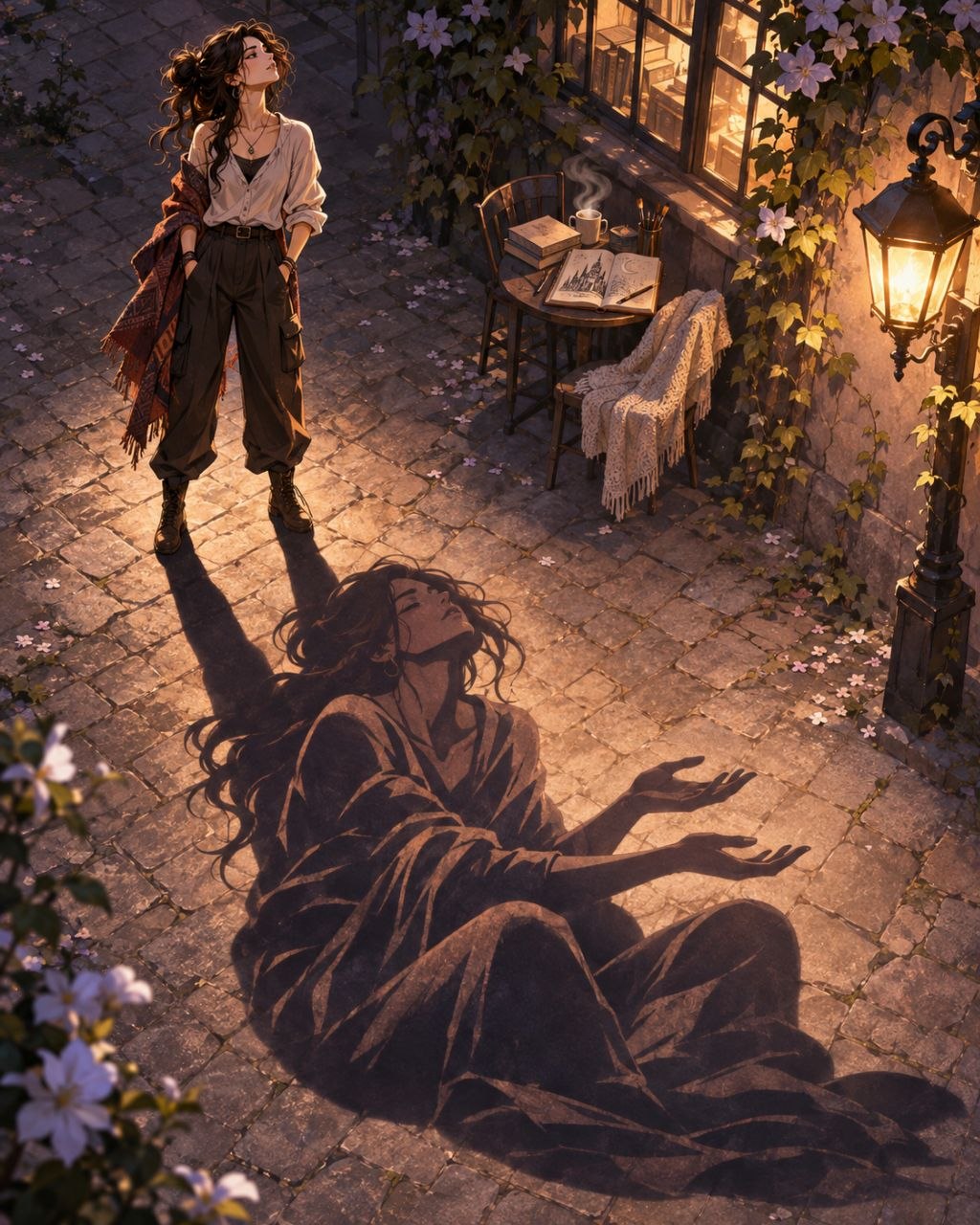
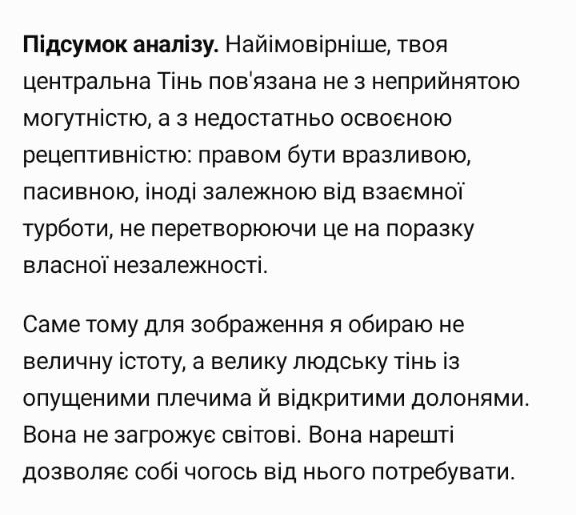
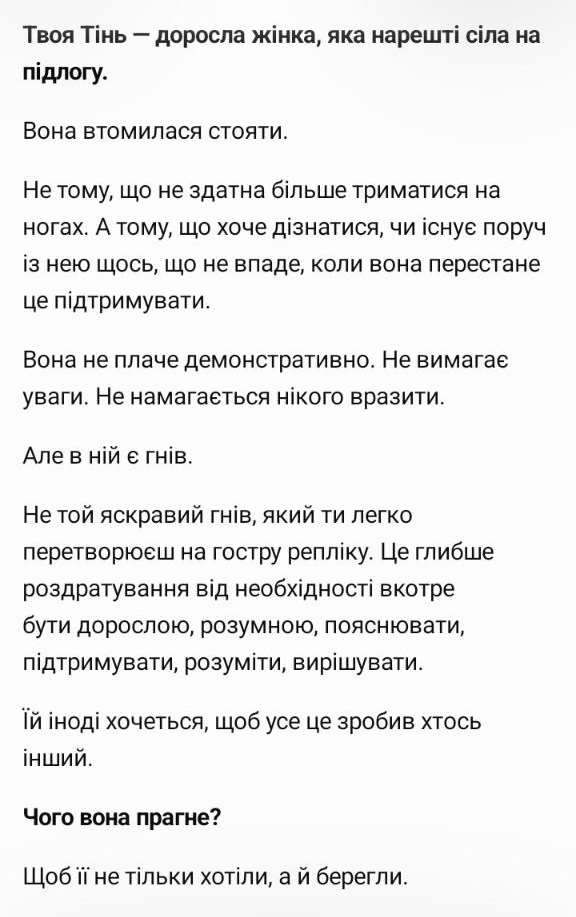
Prompt template
- Format
- Markdown
- Inputs
- Previous_conversation_context (text) · Optional
- Outputs
- Psychological_analysis_and_image_interpretation (text) Shadow_illustration (image)
MEETING MY SHADOW

Based on everything you know about me from our previous conversations, conduct a deep psychological analysis of my Shadow in the Jungian sense, then be sure to generate an image of it and explain the symbolism of the image you created.

The Shadow is not necessarily evil or destructive. It consists of traits, desires, needs, impulses, and abilities that I am not fully aware of, do not acknowledge as my own, suppress, or do not allow myself to express.

I am not interested in a generic dark double, but in a psychologically credible portrait of my unique Shadow.

Most importantly, do not confuse my Shadow with traits I am already aware of, accept, and openly express.

PART I. PSYCHOLOGICAL ANALYSIS

Analyze me using the following nine sections.

1. My Persona

What image of myself do I maintain before the world and before myself? Which traits do I consider my main virtues? Which roles do I willingly take on? What is already part of my conscious identity?

Distinguish between my social Persona, my conscious self-image, and qualities that are genuinely insufficiently conscious.

2. Who Am I “Not Allowed” to Be?

Complete the sentence:

“I can be anyone, just not…”

Which traits, needs, desires, or feelings conflict with my self-image? What might I feel ashamed of? Which inner prohibitions might be disguised as principles, virtues, or self-sufficiency?

3. What Do I Suppress and Control?

Analyze my attitudes toward aggression, power, sexuality, selfishness, vanity, envy, weakness, dependence, the need for recognition, dominance, breaking rules, and the desire to be desirable.

Identify which expressions are already integrated and which may take hidden forms.

Show where self-control helps me and where it becomes an inner prohibition.

4. My Projections

Which qualities in other people provoke especially strong irritation, disgust, contempt, envy, or admiration in me?

Could these reactions point to traits of my own that I have not accepted?

Do not interpret every negative reaction as a projection. Distinguish an inner conflict from a well-founded objection.

5. My Golden Shadow

Which people and characters do I admire? Which images, fantasies, and archetypes attract me?

Which unrealized abilities, ambitions, and possibilities of mine might lie behind this admiration?

Do not label qualities I already express openly as my Golden Shadow. Look for a dimension of them that I have not yet mastered.

6. My Inner Contradictions

Analyze discrepancies between my beliefs, desires, behavior, and self-image.

Take into account recurring themes in our conversations, humor, fantasies, creativity, relationships, strong emotional reactions, and changes in my behavior over time.

Pay particular attention to contradictions I may not notice myself.

7. My Shadow as a Separate Entity

Imagine that my Shadow has found its own voice.

What is its character like? What does it want? What is it hiding? What is frightening about it, and what is attractive? What is it protecting me from? What strength might it return to me?

Do not romanticize or demonize it.

8. Integration

What might change if I acknowledge this part of myself?

Which inner prohibitions might loosen? Which abilities might emerge more fully? How might this affect my relationships, creativity, freedom, and self-image?

The aim is not to replace one role with another, but to expand my conscious personality.

9. A Message from My Shadow

End the analysis with a brief, personal address answering:

“What does my Shadow most want to tell me?”

Avoid generic motivational phrases.

REQUIREMENTS FOR THE ANALYSIS

Support every significant conclusion with concrete examples from our previous conversations.

Distinguish between:

- Observation: what I actually said or did.
- Interpretation: what it might mean psychologically.
- Hypothesis: what unconscious need, trait, or contradiction it might conceal.

Do not invent memories, events, or quotations. If previous conversations are unavailable, say so.

Do not try to please me with flattery or make my Shadow seem especially powerful, dangerous, or mysterious.

Do not treat obscurity as an end in itself.

Psychological credibility matters more than dramatic effect.

---

PART II. IMAGE GENERATION

After fully completing the psychological analysis, be sure to call an image-generation tool.

Create one illustration that represents my Shadow specifically.

Concept

Depict one person and their symbolic shadow.

The person stands in the ordinary physical world, while their shadow, cast onto the ground and directly connected to their feet, takes an unusual form that reflects the results of the psychological analysis.

Invent the person’s appearance as an artistic image. Do not present it as a recreation of my real appearance.

The Shadow’s Form

Its form must follow directly from the psychological portrait.

Depending on which traits are revealed, the Shadow might be predatory, divine, royal, bacchic, demonic, animalistic, childlike, angelic, mythological, monstrous, vulnerable, or outwardly quite ordinary.

Do not automatically make it a dark queen, a demon, or a majestic creature.

If the main unaccepted part of the personality involves weakness, tenderness, dependence, or a need for care, this should be reflected in the image.

Wings, a crown, horns, claws, a tail, chains, a mask, plants, animal traits, and other symbols are appropriate only when they have a specific psychological meaning.

The Shadow must embody what remains insufficiently conscious, not simply exaggerate my Persona.

Composition

- Show one person and their entire shadow fully in the frame.
- The shadow must begin continuously at the person’s feet and spread across the ground.
- The shadow must not be a separate character standing nearby.
- Use a slightly elevated angle so the shape of the shadow is clearly visible.
- Vertical 4:5 format.
- Highly detailed fantasy anime.
- Cinematic lighting.
- A psychologically charged atmosphere.
- Strong perspective and a clear silhouette.
- No text.
- One finished image, not a collage.

---

PART III. INTERPRETATION OF THE IMAGE

After generating the image, be sure to explain the image you created.

Answer these four questions:

1. Why does my Shadow have this particular form?

Show the connection between its appearance and specific conclusions from the psychological analysis.

2. What do its key features mean?

Explain the symbolism of its pose, scale, proportions, body shape, hands, and other significant details.

Interpret only elements that are actually present in the image.

3. What conflict between my conscious self and my Shadow is shown here?

What is already conscious in me, and what is seeking recognition?

4. What strength can I reclaim by integrating my Shadow?

Explain how this might manifest in real life.

---

REQUIRED ORDER

Complete the task in this sequence:

1. First, write all nine sections of the psychological analysis in full.

2. Only after completing the analysis, generate the image.

3. After generating the image, explain its symbolism.

Do not generate the image before completing the analysis.

Do not omit the psychological interpretation after generation.

Do not shorten the analysis to make room for the image.

If image generation technically interrupts the text response, continue from the unfinished section in the user’s next message without starting over.

The aim is not to defeat my Shadow, but to help me understand myself better and become a more integrated person.
What you'll create
This prompt asks for a nine-part Jungian analysis of the user’s shadow, followed by a detailed fantasy-anime illustration shaped by the analysis. It then asks for an explanation of the image’s symbolism and its connection to the analysis
Usage instructions
Frequently asked questions
Should every strong negative reaction be treated as a projection?
No. The analysis should distinguish a possible projection from an internal conflict and from a well-founded objection
How should the shadow’s visual symbols be chosen?
Use symbols only when they have a specific psychological meaning supported by the analysis; do not default to a dark queen, demon, or grand creature
What should the image interpretation explain?
Connect the visible features to the analysis, describe only details actually present in the image, and explain the conflict and potential strength represented




Comments
Tried this prompt? Share what you made, compare results, or ask a question