The Last Rose on the Moon
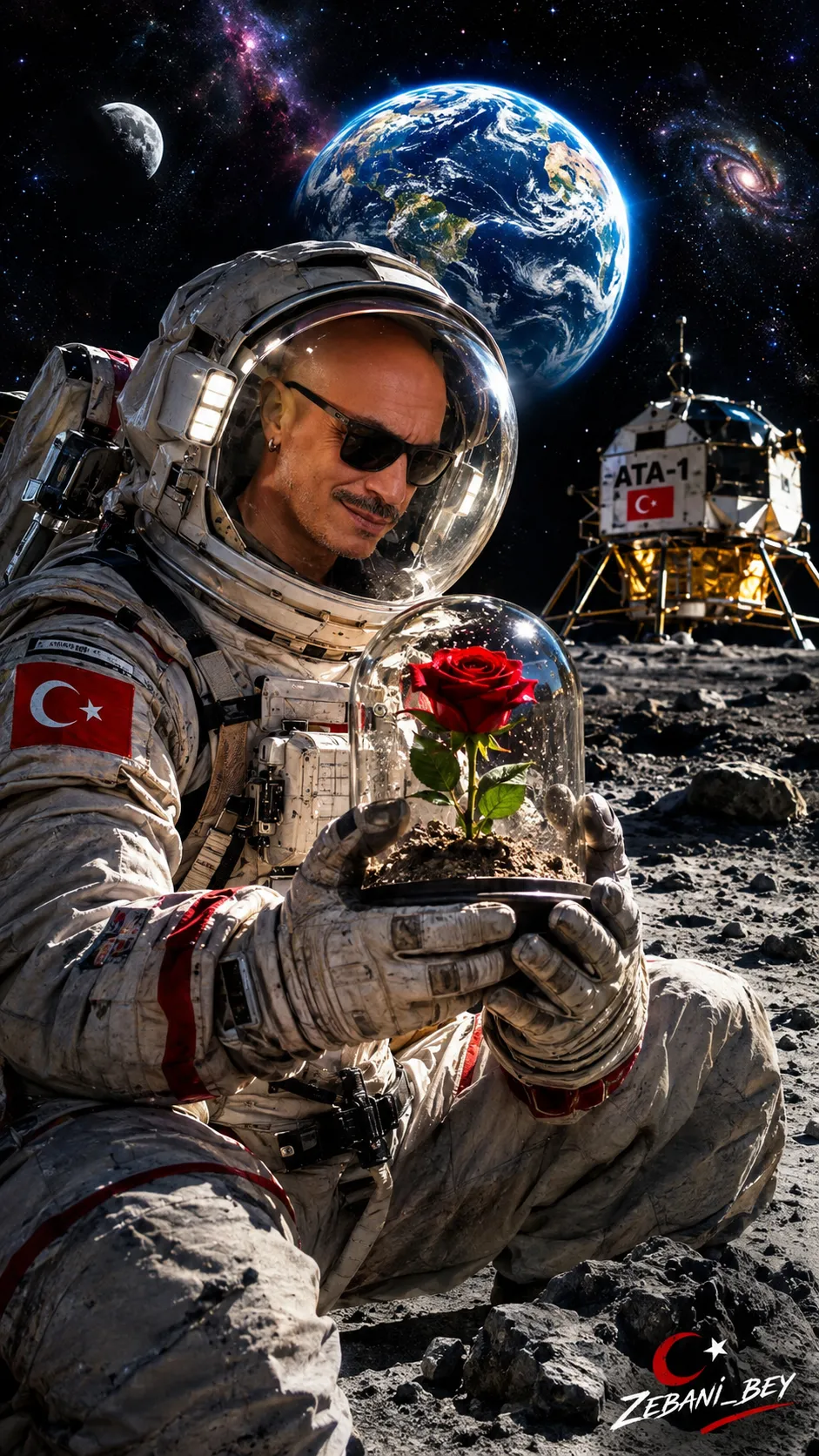
Create a cinematic, photorealistic lunar photograph of a person from a reference photo holding a red rose inside a glass dome, with Earth and the ATA-1 lunar lander in view.
Example outputs
Prompt template
- Format
- Text Parameterized
- Inputs
- Reference_photo (image) · Required signature (text) · Optional · Default: ☾★ ZEBANİ_BEY
- Outputs
- Lunar_scene (image)
MASTER PROMPT | ATA-1 — THE LAST ROSE ON THE MOON

EXTREME PHOTOREALISM | NASA-LEVEL SPACE PHOTOGRAPHY | ULTRA-CINEMATIC | 8K RAW HDR | REAL HUMAN PHOTOGRAPHY | VERTICAL 9:16

1. ABSOLUTE FACE AND PHYSICAL IDENTITY PRESERVATION

Use the real person in the uploaded reference photo as the sole and absolute source of identity.

Preserve the person's facial anatomy, head shape, eyes, nose, lips, chin, natural facial asymmetry, age, skin tone, skin pores, wrinkles, mustache and beard characteristics, and hair or baldness exactly.

Do not change the reference person's body build, shoulder width, or physical proportions.

Do not beautify, rejuvenate, redesign, or transform the person into someone else.

RESULT: The image must show the real person from the reference photo as if photographed on the lunar surface.

2. MAIN SCENE — THE LUNAR SURFACE

Create an extraordinarily realistic, cinematic space photograph set on the Moon, in a vertical 9:16 composition.

The lunar terrain must be scientifically realistic. Show fine gray regolith dust, sharp-edged craters, rocks of various sizes, natural ridges and depressions, astronaut footprints, and extremely detailed microscopic surface textures.

Sunlight must be hard, direct, and high-contrast, as appropriate for the airless lunar surface. Shadows must extend in physically accurate directions.

3. CENTER OF THE BACKGROUND — MAGNIFICENT EARTH

Place the extraordinarily beautiful and realistic planet Earth in the center of the background, rising above the lunar horizon.

Render Earth's deep-blue oceans, white cloud systems, continents, blue atmospheric rim glow, and day-night boundary in detail worthy of NASA space photography.

Earth must be one of the scene's most striking visual elements. Its size should create cinematic impact while preserving the planet's spherical anatomy and natural appearance.

Earth's central background position and deep-blue beauty must not change.

4. DEEP SPACE — CREATIVE FREEDOM

Leave the selection of all celestial bodies, star-forming regions, nebulae, galaxies, planets, and cosmic details beyond Earth to the AI's creativity.

Let the AI freely design the space vista best suited to the composition's aesthetics, depth, and cinematic coherence.

These elements must be visually striking, have realistic astronomical textures, and evoke professional astrophotography.

Avoid any fantasy illustration, plastic CGI, or video-game appearance.

5. MAIN SUBJECT — ASTRONAUT

Place the real person from the reference photo in the foreground and center of the image, wearing professional astronaut clothing.

Have the astronaut kneel on one knee on the lunar surface or sit naturally.

The suit must consist of the multilayered protective fabrics, pressure connections, metal locking mechanisms, oxygen systems, connecting hoses, and technical equipment used in real space missions.

Render dust on the fabric, signs of use, stitching, and material textures in microscopic detail.

Include a realistic Turkish flag patch on the astronaut's sleeve.

The helmet visor must be transparent. The reference person's face must be clearly visible, sharp, and easily recognizable. Preserve the black sunglasses and characteristic accessories present in the reference.

Reflections on the visor must not conceal the face.

6. EMOTIONAL CENTER — THE RED ROSE UNDER A GLASS DOME

Have the astronaut carefully hold a transparent glass dome with both hands, containing a single living red rose.

Make the rose extremely realistic, with deep-red, velvety petals. Show its fine veins, natural petal curls, green stem, and leaves in detail.

Place the rose's roots in a small amount of natural soil at the bottom of the dome.

Design the glass dome as a sealed, pressurized environment in which the flower could live.

Have the astronaut incline their head slightly and gaze admiringly at the rose. Give them a sincere, natural, gentle, emotional smile.

The scene's central feeling: In the endless emptiness of space, life and love are held within a tiny red rose.

7. ATA-1 — TURKISH LUNAR MODULE

Place a scientifically and engineering-plausible lunar lander on the lunar surface in a suitable midground or background position where it does not obstruct the composition.

Equip the module with metallic landing legs, gold-colored thermal insulation layers, antennas, communication systems, observation cameras, a ladder, and technical panels.

Place a clearly visible, correctly rendered Turkish flag on the module's exterior.

Immediately above the flag, write the following in large, sharp, easily readable letters:

ATA-1

Render the module's feet where they meet the lunar dust, and the marks they leave in the ground, with physical realism.

8. CAMERA, LIGHTING, AND PHOTOGRAPHIC QUALITY

Use the aesthetic of a high-end RAW photograph taken on the lunar surface by a professional space photographer.

- 8K ultra-high-resolution RAW HDR
- Hasselblad medium-format photography aesthetic
- 50 mm cinematic lens
- Realistic optical depth of field
- Precise facial and skin texture
- Physically accurate light and shadows
- Natural metal, fabric, glass, and soil textures
- Controlled reflections and high dynamic range
- Sharp main subject and detailed lunar terrain
- Natural colors and a strong cinematic composition

Let the blue tones of Earth and the red rose inside the dome create a striking color contrast with the gray lunar surface.

Do not use anime, cartoons, digital illustration, artificial 3D rendering, plastic skin, or exaggerated beautification.

9. CUSTOM SIGNATURE — CREATOR CREDIT

Add an elegant, professional artist's signature in the lower-right corner without disrupting the composition's integrity.

The signature text must be exactly:

${signature:☾★ ZEBANİ_BEY}

The crescent-and-star symbol should have an aesthetic design evocative of the Turkish flag.

Make the signature fine, stylish, legible, and consistent with the image's cinematic atmosphere. It must not cover the main subject, the lunar module, or important scene details.

10. FINAL QUALITY REQUIREMENTS

The finished work must look not like an image generated by AI, but like an extraordinarily high-quality professional photograph of a real person taken on the lunar surface.

Preserve the reference person's facial identity; make Earth captivating and central in the background; keep the ATA-1 module and Turkish flag clearly visible; and make the red rose the emotional focal point.

ABSOLUTE PHOTOREALISM | AUTHENTIC HUMAN IDENTITY | MASTERPIECE SPACE PHOTOGRAPHY | CINEMATIC EMOTIONAL STORYTELLING | 8K RAW HDR | VERTICAL 9:16
Replace the ${…} placeholders with your values
before using this prompt. See parameters
and defaults below
Parameters
Replace each placeholder with your own value, or use its default when one is provided
${signature:☾★ ZEBANİ_BEY}
signature
Default: ☾★ ZEBANİ_BEY
What you'll create
The supplied person appears in a cinematic moon-surface scene with an ATA-1 module and Turkish flag. Earth anchors the background while the red rose becomes the emotional focal point.
Usage instructions
Provide a clear reference photo so the depicted person can be based on it. The scene depends on preserving that person's appearance while placing them with the rose, Earth, and ATA-1; adjust the signature text if you want different creator credit.
Frequently asked questions
Does this assert an actual lunar mission photograph?
No. It requests a constructed cinematic image.
Which small object carries the emotional emphasis?
The red rose.




Comments
Tried this prompt? Share what you made, compare results, or ask a question