Tyranid Attack in a Ruined Imperial Station
Create a photorealistic live-action Warhammer 40,000 survival-horror still of a person from a reference photo struggling to hold back a Tyranid in a devastated underground station.
Example outputs
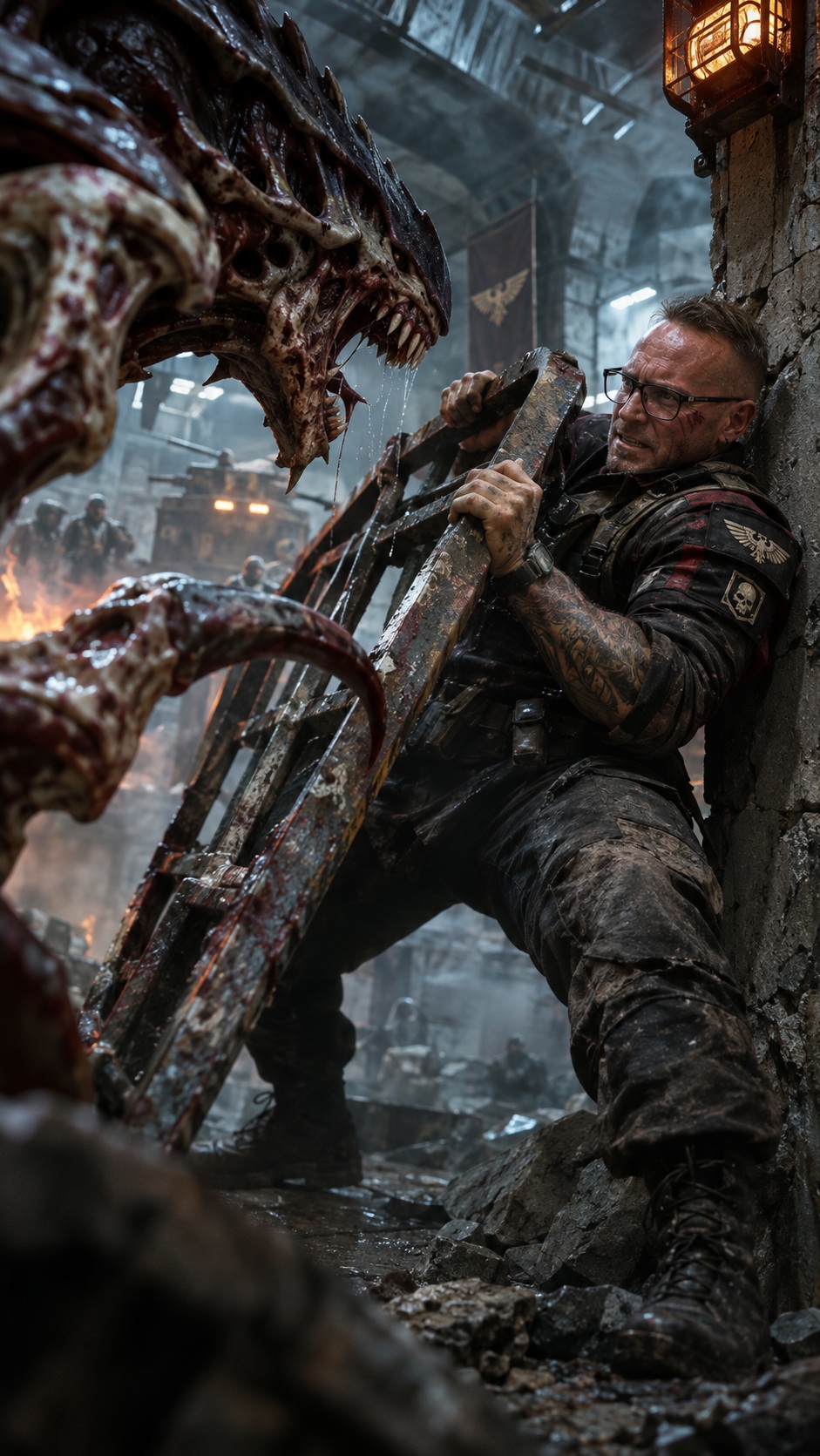
AI-generated video of a person braces a broken metal railing against a lunging Tyranid in a fog-filled, ruined Imperial transit station as fires burn and Guardsmen flee in the distance.
Download video result 2Prompt template
- Format
- Text
- Inputs
- Reference_photo (image) · Required
- Outputs
- Cinematic_still (image)
Create an ULTRA-PHOTOREALISTIC LIVE-ACTION CINEMATIC STILL from a high-budget Warhammer 40,000 survival horror film.

FORMAT:
Strict vertical 9:16, 1080x1920.
Maximum photorealism, live-action cinematic photography, physically believable materials, realistic human anatomy, realistic scale.

IDENTITY / SUBJECT REFERENCE — ABSOLUTE PRIORITY:

Use the uploaded reference photograph of the person as the primary and authoritative identity reference.

Recreate the exact individual shown in the reference photograph as the human protagonist in this scene.

Preserve the person's:
face shape, head shape, jawline, forehead, nose, lips, eyes, eyebrows, ears, cheekbones, natural facial asymmetry, hairline, hairstyle, age, natural skin texture, facial features and recognizable identity.

Preserve the person's real body proportions and physique as represented in the reference photograph:
height, shoulder width, torso length, waist, neck, arm length, forearm thickness, hand size and natural muscle volume.

Do not beautify, de-age, age up, redesign the face, alter the body proportions, exaggerate muscles or transform the person into a generic action hero.

The human must clearly remain the same real person from the reference photograph.

SCENE — “TEETH IN THE FOG”:

Inside a devastated Imperial underground transit station, the referenced person is suddenly attacked by a Tyranid Hormagaunt emerging from dense battlefield smoke.

The creature has lunged toward the person with its claws and open jaws.

The person is not fighting the creature with a conventional weapon. They have grabbed a broken section of thick metal railing with both hands and are using it as an improvised physical barrier between their body and the Tyranid's head.

The Tyranid's claws have struck the metal barrier.
Its jaws are only centimeters from the barrier.

The person is braced backward against a damaged concrete pillar, both legs supporting their weight, shoulders and arms visibly straining under the force.

The moment must communicate the terrifying difference in scale and strength between an ordinary human and the alien organism.

The human is surviving through leverage, bracing and desperation rather than superhuman strength.

CAMERA:

Very low camera positioned approximately 45 cm above the floor, almost at the Tyranid's shoulder height.

Camera distance approximately 2 meters.

Use an 85mm full-frame equivalent lens to compress the layers naturally.

Camera positioned slightly behind the Tyranid's front shoulder, looking diagonally toward the human.

Do not use a wide-angle lens.

FOREGROUND:

The Tyranid's massive armored shoulder and one claw occupy the extreme foreground close to the lens, partially obscuring the frame.

The claw is physically positioned between the camera and the human.

The foreground creature creates strong natural occlusion, scale and parallax.

MIDGROUND:

The referenced person is pressed against the damaged concrete pillar.

Their body is turned approximately 20 degrees away from camera.

Their face is visible through the gap between the Tyranid's head and claw.

Head rotation approximately 55 degrees toward the creature, chin slightly raised because they are looking at its head and jaws.

Their gaze is fixed on the Tyranid, never toward the camera.

The person's expression shows genuine physical strain, fear, concentration and survival instinct.

Their clothing should be adapted naturally into the Warhammer 40,000 environment while remaining believable and subordinate to the person's identity.

Use practical, worn, dark Imperial survival/combat clothing appropriate to the environment.

The person's forearms and natural hands must remain clearly visible gripping the metal barrier.

Do not introduce random armor that obscures the person's identity or changes their recognizable silhouette.

BODY PROPORTION LOCK:

Preserve the exact real proportions of the person from the uploaded reference photograph.

Maintain their real height, natural physique, shoulder width, torso length, arm length, forearm thickness, hand size and muscle volume.

Do not enlarge their muscles to make them appear capable of overpowering the Tyranid.

Their apparent strength must come from leverage, bracing, body positioning and desperation.

Do not enlarge hands or forearms.

Do not alter torso length or shoulder width.

Do not turn the person into a bodybuilder or exaggerated superhero.

The human must look like the same ordinary real person photographed in an extreme survival situation.

BACKGROUND:

Behind the human, the enormous underground transit station disappears into dense battlefield fog.

Distant Imperial vehicles burn behind shattered platforms.

Small silhouettes of fleeing Imperial Guardsmen move between damaged pillars.

Emergency lights flicker through the smoke.

Broken transit machinery, cables, debris, damaged Imperial architecture and distant fires create multiple distinct spatial layers.

The environment must extend far beyond the immediate struggle.

Create strong atmospheric perspective between foreground, middle ground and distant background.

LIGHTING:

Cold bluish atmospheric light filters through dense smoke.

Flickering amber emergency lamps illuminate portions of the ruined station.

The Tyranid's wet organic surfaces catch realistic specular highlights.

The metal barrier shows scratches, corrosion, blood, dirt and realistic reflections.

Wet concrete and debris reflect scattered environmental light.

Volumetric battlefield haze creates natural light shafts and atmospheric depth.

The human's face must retain realistic skin texture, pores, wrinkles and natural imperfections.

No artificial beauty lighting.

No studio lighting.

ANATOMY AND PHYSICS:

The person's hands must grip the metal barrier naturally.

Both hands must have anatomically correct fingers and believable pressure around the metal.

Elbows remain slightly bent under force.

Shoulders connect correctly to the torso.

Feet remain firmly planted on the floor.

Leg positioning must explain how the person is resisting the Tyranid's forward momentum.

The Tyranid's claws must make real physical contact with the metal barrier.

The barrier must visibly flex, scrape or deform against the concrete under the creature's force.

The Tyranid's body must have a believable center of gravity.

The creature's weight and momentum must visibly affect the human's posture.

The human cannot physically overpower the Tyranid.

No floating creature.

No impossible human strength.

No impossible joint positions.

No duplicated limbs.

No physically impossible contact.

CINEMATIC COMPOSITION:

The image should feel like a single frame captured during a real high-budget live-action Warhammer 40,000 film.

Use layered depth:

EXTREME FOREGROUND:
Tyranid shoulder, claw and environmental debris extremely close to lens.

MIDDLE GROUND:
The human protagonist and the immediate physical struggle.

DEEP BACKGROUND:
Ruined Imperial transit station, burning vehicles, fleeing soldiers, smoke, emergency lighting and distant architecture.

The human must remain clearly readable despite the enormous Tyranid occupying the foreground.

Use restrained cinematic depth of field.

Maintain realistic atmospheric perspective.

Preserve physically believable scale between the human, Tyranid and architecture.

STYLE:

Ultra-photorealistic live-action Warhammer 40,000 cinema.

Real human skin.
Realistic anatomy.
Realistic wet organic surfaces.
Real concrete.
Real steel.
Real dust.
Real smoke.
Real fire.
Real atmospheric scattering.
Realistic cinematic exposure.
Practical-looking creature effects.
Physically believable lighting.

The final image must look like a frame captured by a professional cinema camera during an expensive live-action production.

It must never look like a videogame screenshot, digital illustration, concept art, 3D render or CGI showcase.

NEGATIVE PROMPT:

No different person, no generic male face, no generic human protagonist, no altered identity, no face replacement, no beautified face, no de-aged face, no aged-up face, no altered facial structure, no altered body proportions, no exaggerated muscles, no bodybuilder physique, no superhero physique, no oversized shoulders, no oversized arms, no oversized hands, no altered height, no altered torso length, no distorted anatomy, no extra fingers, no missing fingers, no duplicated limbs, no fused limbs, no broken wrists, no impossible joints, no impossible biomechanics, no floating creature, no impossible human strength, no plastic skin, no waxy skin, no CGI face, no videogame appearance, no cartoon, no illustration, no generic action-hero pose, no heroic flexing, no posing for camera, no direct eye contact with camera, no pointing finger, no lecturing pose, no artificial smile, no clean studio clothing, no random Space Marine power armor, no excessive armor obscuring the person, no flat background, no flat composition, no decorative foreground without physical purpose, no wide-angle body distortion, no fisheye distortion, no artificial vignette, no poster layout, no advertising composition, no text, no caption, no headline, no instructional graphics.
What you'll create
A reference-guided person strains against a concrete pillar while a huge Tyranid lunges into a metal barrier. The creature fills the close foreground, with burning vehicles and fleeing figures lost in blue smoke and amber emergency light behind the struggle.
Generation settings
Advanced settings
- Negative prompt
- No different person, no generic male face, no generic human protagonist, no altered identity, no face replacement, no beautified face, no de-aged face, no aged-up face, no altered facial structure, no altered body proportions, no exaggerated muscles, no bodybuilder physique, no superhero physique, no oversized shoulders, no oversized arms, no oversized hands, no altered height, no altered torso length, no distorted anatomy, no extra fingers, no missing fingers, no duplicated limbs, no fused limbs, no broken wrists, no impossible joints, no impossible biomechanics, no floating creature, no impossible human strength, no plastic skin, no waxy skin, no CGI face, no videogame appearance, no cartoon, no illustration, no generic action-hero pose, no heroic flexing, no posing for camera, no direct eye contact with camera, no pointing finger, no lecturing pose, no artificial smile, no clean studio clothing, no random Space Marine power armor, no excessive armor obscuring the person, no flat background, no flat composition, no decorative foreground without physical purpose, no wide-angle body distortion, no fisheye distortion, no artificial vignette, no poster layout, no advertising composition, no text, no caption, no headline, no instructional graphics.
Usage instructions
Frequently asked questions
Does the person overpower the creature?
No. Survival depends on leverage, planted feet and the damaged railing rather than exaggerated strength.
Should the protagonist look into the camera?
No. Their gaze stays fixed on the creature’s head and jaws.




Comments
Tried this prompt? Share what you made, compare results, or ask a question