Underwater Encounter with a Colossal Alien Creature
Create a photorealistic cinematic still of a person and a fellow explorer confronting a gigantic alien sea creature through the cracked window of a damaged underwater vessel. Requires a reference photo for the main character’s identity.
Example outputs
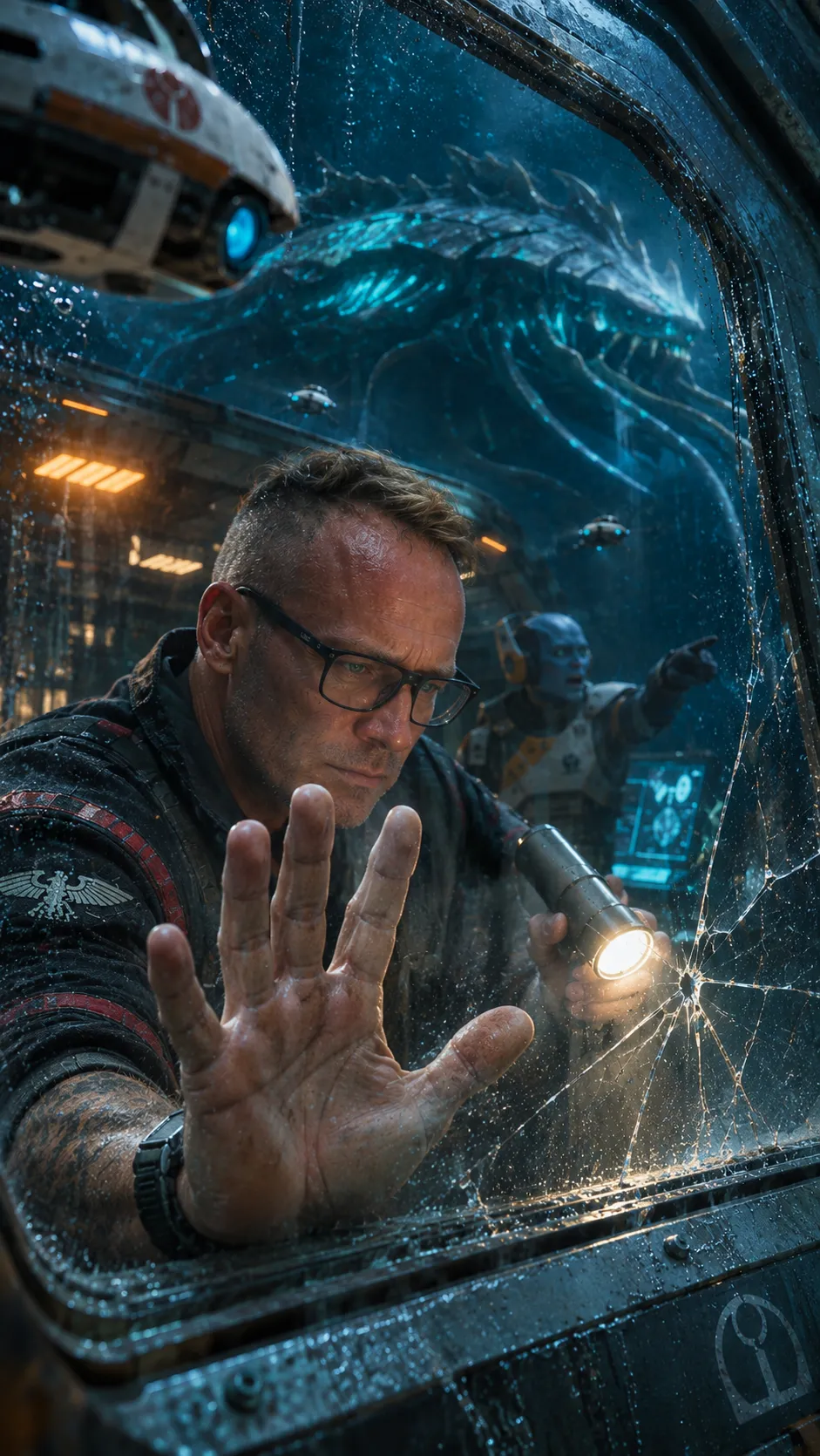
AI-generated video of a man presses his hand against a cracked submarine window as a second explorer shines a flashlight toward a colossal alien sea creature outside.
Download video result 2Prompt template
- Format
- Text
- Inputs
- Reference_photo (image) · Required
- Outputs
- Cinematic_still (image)
Create an ultra-photorealistic live-action cinematic still from a high-budget Warhammer 40,000 science-fiction war film.

FORMAT:
Strict vertical 9:16.
Maximum photorealism.
Live-action cinematic realism.
No illustration.
No concept-art appearance.
No CGI aesthetic.
No video-game render.

MAIN HUMAN CHARACTER — IDENTITY REFERENCE:
Use the uploaded photograph as the ONLY source of the main human character's identity and appearance.

Preserve the person's exact recognizable facial identity:
facial structure, head shape, jawline, forehead, nose, lips, ears, cheekbones, eye shape and spacing, natural asymmetry, age, skin texture, hairline, hairstyle and body proportions.

The person must remain clearly recognizable as the individual from the reference photograph.

Do not beautify, rejuvenate, age, masculinize, feminize or otherwise alter the person's identity.

Do not copy the original background, clothing, pose, lighting or camera angle from the reference photograph.

The reference photograph determines ONLY who the person is.

SCENE:
Inside a damaged Imperial underwater exploration vessel deep beneath an alien ocean.

The vessel has suffered structural damage.

The interior is partially flooded.

Water covers the lower sections of the compartment.

Rain-like streams of water and condensation run across the reinforced glass and metal surfaces.

The main character is inside a cramped observation compartment positioned directly beside a huge reinforced panoramic viewing window.

The window is heavily damaged.

A large spiderweb of cracks spreads across the glass.

Water droplets and streams cover the entire surface.

Beyond the glass is an enormous alien aquatic creature moving through the dark blue water.

The creature is gigantic — its body extends far beyond the visible frame.

It resembles a colossal deep-sea predator with an elongated armored body, enormous fins and multiple ridged biological structures.

Its silhouette is partially obscured by darkness and suspended particles.

Only portions of its enormous body are visible through the damaged glass.

The creature's presence should feel physically enormous and threatening.

The creature must remain completely outside the vessel.

The main character has just realized how close the creature is.

He is crouched or leaning close to the observation window.

One hand is pressed flat against the wet reinforced glass.

His palm and fingers are clearly visible in the foreground.

His expression is tense, concentrated and deeply focused.

He is NOT looking at the camera.

His gaze is directed through the glass toward the gigantic creature.

His posture communicates cautious observation rather than theatrical fear.

SECOND CHARACTER:
A second Imperial explorer is positioned behind the main character.

He is partially obscured by the main character and the damaged interior.

He holds a powerful cylindrical flashlight in both hands or one hand.

The flashlight beam is directed toward the underwater creature.

The beam creates a bright cone of light through the murky water outside.

The second character is looking toward the creature and appears to be urgently observing what is happening.

He must remain secondary to the main character.

BACKGROUND:
Behind the characters is the damaged interior of an Imperial exploration vessel.

Visible elements include:
reinforced structural ribs,
industrial metal walls,
pipes,
cables,
sealed equipment,
damaged control panels,
small illuminated displays,
emergency lighting,
wet surfaces,
condensation,
floating particles and water droplets.

The environment should feel cramped, functional and militarily engineered.

A small amount of warm industrial lighting contrasts against the cold blue illumination from the alien ocean.

MAIN CHARACTER — POSE:
The main character is positioned extremely close to the observation window.

His torso is angled toward the glass.

His head is turned approximately 35–55 degrees away from the camera, toward the creature.

His chin is slightly lowered.

His eyes are directed outward through the glass.

One arm reaches forward.

The palm of that hand is pressed naturally against the glass.

The fingers are spread naturally with realistic anatomy.

The second arm remains closer to the body.

Do not make the character pose heroically.

Do not make him look at the camera.

Do not make him point.

Do not create a theatrical gesture.

The gesture should feel instinctive, as if he has just approached the window after noticing something enormous outside.

CAMERA:
Camera is positioned INSIDE the vessel, extremely close to the damaged observation window.

The camera is approximately 30–60 cm from the main character.

Use an intimate close-range perspective.

The character's hand pressed against the glass dominates the lower-middle foreground.

The main character's face occupies the central area of the frame.

The second explorer appears behind him in the middle ground.

The enormous creature fills much of the background beyond the glass.

The cracked glass physically separates the camera from the creature.

The camera should feel as if it is another crew member standing inside the cramped compartment.

Use strong foreground / middle-ground / background separation.

FOREGROUND:
The character's wet hand pressed against cracked glass.
Individual water droplets.
Sharp spiderweb cracks.
Metal window frame.
Wet reflective surfaces.

MIDDLE GROUND:
Main character's face and upper body.
Second explorer.
Flashlight and beam.
Damaged interior equipment.

BACKGROUND:
The gigantic alien creature beyond the reinforced glass.
Dark blue ocean.
Suspended particles.
Distant underwater structures and shadows.

OPTICAL EFFECT:
Shoot through wet, damaged reinforced glass.

Water droplets and cracks should remain physically attached to the glass plane.

Some droplets should be sharply visible near the lens.

Other parts of the glass should distort the creature slightly through refraction.

The creature must remain recognizable despite the water, cracks and distortion.

The glass should create realistic optical separation between the characters and the underwater environment.

LIGHTING:
Cold deep-ocean blue ambient light dominates the scene.

The gigantic creature is illuminated primarily by scattered cyan-blue underwater light.

The second character's flashlight creates a strong localized warm-white beam.

Warm industrial emergency lights illuminate portions of the characters and interior.

The main character's face receives a mixture of cold blue reflected light and subtle warm interior light.

Wet skin must produce realistic specular highlights.

Water droplets must catch individual points of light.

The contrast should feel cinematic but physically believable.

CREATURE:
The creature must look enormous and biologically plausible.

Deep-sea alien predator.

Dark semi-translucent wet skin or armored biological surface.

Long streamlined body.

Massive fins.

Ridged dorsal structures.

Subtle bioluminescent cyan highlights.

Partially visible head and eye area.

The creature should appear to be slowly passing extremely close to the vessel.

Its scale must be communicated by comparison with the human characters and the submarine window.

Do not make it resemble a dragon, dinosaur, fantasy monster or cartoon creature.

It should feel like an unknown real biological organism discovered in an alien ocean.

PHYSICAL REALISM:
All objects obey real-world physics.

The main character's hand must physically contact the glass.

Fingers must have realistic proportions and joints.

Water droplets must remain on the glass surface.

The flashlight must be correctly held.

The flashlight beam must interact naturally with suspended particles in the water.

The creature must remain behind the glass.

No objects may float inexplicably inside the vessel.

No impossible body positions.

No duplicated equipment.

No duplicated limbs.

CINEMATOGRAPHY:
32mm anamorphic cinema lens.

Very close observational camera.

High-end live-action science-fiction cinematography.

Natural handheld camera.

Moderate depth of field.

Main character's face and hand are highly detailed.

The second character remains slightly softer but recognizable.

The creature is readable through atmospheric underwater haze.

Subtle anamorphic lens characteristics.

Realistic film grain.

High dynamic range.

Physically accurate reflections and refraction.

No artificial over-sharpening.

No excessive bokeh.

No flat composition.

EMOTIONAL TONE:
The scene should feel like a genuine discovery inside a dangerous underwater military expedition.

The human characters are not posing for a photograph.

They have unexpectedly encountered something enormous outside the vessel.

The main character is silently trying to understand what he is seeing.

The second explorer is attempting to illuminate the creature with his flashlight.

The creature is passing silently outside the damaged observation window.

The moment should feel tense, intimate and claustrophobic.

It should look like a single frame from a massive live-action science-fiction war movie.

NEGATIVE PROMPT:
No different person.
No generic male face.
No altered identity.
No face replacement artifacts.
No beautified face.
No younger or older face.
No altered age.
No altered facial structure.
No altered body proportions.
No exaggerated muscles.
No superhero physique.
No plastic skin.
No CGI face.
No illustration.
No concept art.
No video-game render.
No cartoon.
No fantasy illustration.
No pointing finger.
No lecturing pose.
No looking at camera.
No heroic pose.
No theatrical expression.
No distorted anatomy.
No extra fingers.
No missing fingers.
No duplicated fingers.
No duplicated limbs.
No broken wrists.
No impossible hand anatomy.
No floating objects.
No duplicated equipment.
No anthropomorphic creature.
No dragon.
No dinosaur.
No fantasy monster.
No creature inside the vessel.
No creature breaking through the glass.
What you'll create
A reference-based explorer and a companion occupy a close, layered vessel interior, with a hand pressed to the viewing glass. An enormous alien creature remains outside in the water, creating a photorealistic science-fiction encounter within a vertical frame.
Generation settings
Advanced settings
- Negative prompt
- No different person.
Usage instructions
Frequently asked questions
Does the creature enter the vessel?
No; it remains outside and does not break through the glass.
Is the creature intended as a dragon or dinosaur?
No; the source explicitly excludes those familiar fantasy and prehistoric forms.





Comments
Tried this prompt? Share what you made, compare results, or ask a question