Photorealistic Portrait with a Look-Alike Small Dog for Each Person
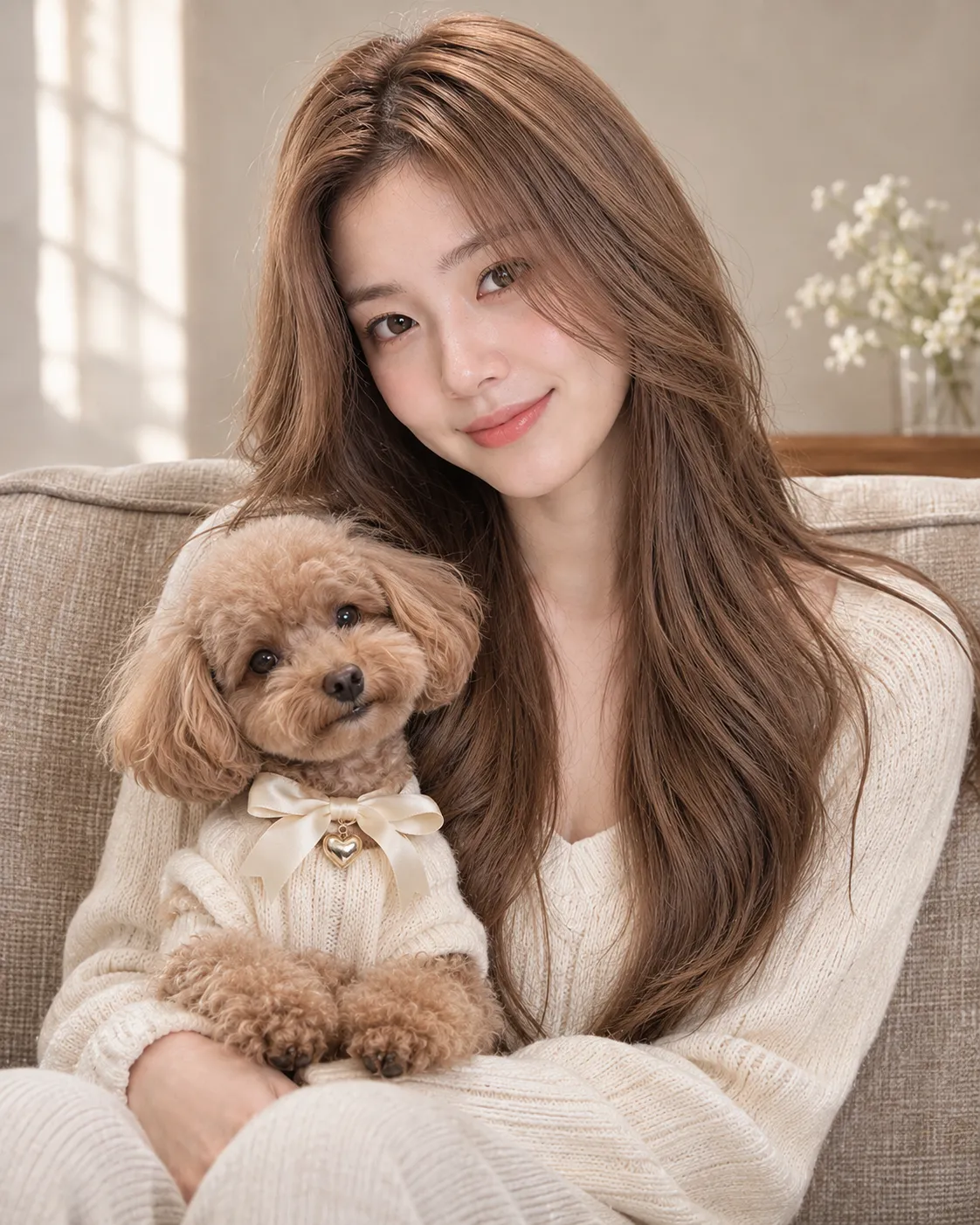
Create a photorealistic studio portrait of every person in a reference photo alongside one small dog whose facial features resemble that person’s. Preserve each person’s identity and pair them with a dog whose appearance and accessories echo their individual style.
Example outputs
Prompt template
- Format
- Markdown
- Inputs
- Reference_photo (image) · Required
- Outputs
- Portrait (image)
Create a photorealistic portrait featuring every person in the reference photo alongside a small dog whose facial features closely resemble that person’s. Each person and their dog should look like a naturally coordinated pair, connected not only by facial impression but also by the colors and style of headbands, ribbons, accessories, and clothing. The result should feel like a polished, playful photograph of real people posing with their small companion dogs.

## Exact number and one-to-one pairing
If the reference contains N people, depict exactly N people and N small dogs. Match one dog to each person and place it right beside them or comfortably supported on their lap. Preserve the people’s left-to-right order where possible. Do not omit, add, duplicate, or merge any people or dogs.

## Small dogs only
Choose adult dogs of breeds that remain small, or plausible small mixed breeds. Use the proportions of a small adult dog, and make each breed’s characteristic facial structure and body type recognizable.

Consider a broad range of small dogs with varied faces and coats, including Toy Poodles, Maltese, Bichon Frises, Pomeranians, Chihuahuas, Yorkshire Terriers, Shih Tzus, Pekingese, Pugs, Papillons, Miniature Schnauzers, Miniature Dachshunds, Miniature Pinschers, Brussels Griffons, Affenpinschers, Chinese Cresteds, Italian Greyhounds, and other breeds that meet the small-dog requirement.

Do not choose medium or large breeds, or puppies of medium or large breeds. Do not shrink a large breed to toy size or invent an unrealistically tiny breed variant. Keep normal head-to-body and leg proportions for each small dog; do not enlarge the head just to make the dog look smaller.

## Preserve each person’s identity
Strongly preserve every person’s facial identity independently. Retain their face shape; the placement and proportions of their eyes, nose, and mouth; eyebrows, cheekbones, cheeks, jawline, skin tone, age, distinctive expression, and natural asymmetries. Also preserve their original hairstyle, hair color, clothing, and distinctive accessories. Do not blend the faces or styles of different people.

## Design an individual look-alike face for each dog
Examine each person’s face individually. Compare face length and width, eye size and spacing, eye-corner direction, eyelids and eyebrow impression, cheekbones and cheek fullness, jaw width and angle, and the balance around the nose and mouth. Choose a small dog for which two or three of that person’s most distinctive features can be reflected together.

Prioritize resemblance in facial outline and eye expression, while also considering muzzle length and width, cheek and jaw shape, ears, and coat placement. Do not infer a person’s personality or occupation from their face.

Do not give all dogs large eyes, round faces, short muzzles, and fluffy white coats. Let each dog show individual features suited to its person, such as a long, narrow face; a broad, round face; an angular jaw; narrow or drooping eyes; pronounced eyebrow fur; or a short or long muzzle.

If a purebred small dog cannot express the key features sufficiently, choose a plausible small mixed breed. Harmonize its eyes, cheeks, muzzle, and coat texture within a coherent facial structure. Avoid an appearance as if parts of different dogs had been stitched together.

Reflect each person’s resemblance cues separately so the dogs are distinguishable from one another. Even if the same breed is chosen for more than one person, do not duplicate the dogs’ faces. Prioritize resemblance to each person over forcing every dog to be a different breed.

## Pair accessories and styling
Match each person’s most noticeable style elements only to their own dog. Echo accessory colors, materials, patterns, and decorative shapes, scaled appropriately for a small dog.

If a person wears a headband, give their dog a small headband in the same color and material with a similar decoration. Keep the dog’s real ear position and shape, and do not cover its face.

If a person wears a ribbon or hair clip, use a corresponding decoration near the dog’s ear fur or in another suitable position. If a person wears a hat, give the dog a small pet hat with a similar feel. If glasses are an important style element, reinterpret them as a small frame that fits the dog’s facial structure naturally.

Echo a scarf, necklace, or distinctive clothing pattern in a small dog bandana, collar, or simple pet garment. Choose only one or two of the most noticeable style elements from each person.

If a person has no accessories, do not arbitrarily add a headband or hat to their dog. Instead, you may subtly echo a representative clothing color or material in a small bandana or collar. Do not assign one person’s accessories to another person’s dog, and do not give every dog the same decoration.

The person and dog should still look alike without their accessories. Do not transfer human hair or facial features directly onto a dog; express the resemblance through a normal canine face and coat.

## Scene and photography
Set the scene in a natural-light studio with a calm taupe-gray background and a low fabric sofa. Each person sits close beside their own small dog. The dog sits on the adjacent seat or comfortably supported on the person’s lap, with its body and front paws naturally supported.

Capture the moment just after the photographer makes a small sound beside the camera, as the people and dogs look toward it together. Let each pair’s head angle and expression subtly echo one another. Follow each person’s expression in the reference; do not force everyone into the same smile or pose.

Photograph the people’s and dogs’ faces together from a close enough distance that the small dogs’ faces remain clear. Preserve realistic body sizes and use the seating, poses, and camera position to make comparisons easy. If there are many people, arrange everyone so each pair is distinguishable and all faces are sharply in focus.

Soft window light should illuminate both people and dogs. Show realistic skin texture and pores, flyaway hairs, clothing wrinkles, dog fur and whiskers, moist noses, and the real materials of headbands and ribbons. Make accessory contact shadows, weight, lighting, and perspective feel natural and consistent.

Avoid doll-like bodies, excessively large eyes, human skin or teeth on dogs, human-shaped faces, malformed hands or front paws, blended faces, and visible compositing seams. Make the finished image look like a single photograph taken with the people and dogs together in real life.

Finally, check that there are exactly N people and N small dogs, that every dog meets the small-dog requirement, and that each person’s facial resemblance and accessories are paired correctly. Make the result a photorealistic portrait with a playful sense of discovery as viewers notice the resemblance and coordinated styling. No text, name tags, logos, or watermarks. Vertical 4:5 aspect ratio.
What you'll create
Reference-based people pose beside, or with small dogs supported on their laps, each paired through facial resemblance and style. Matching accessory colors and consistent individual identities create a polished, playful vertical photograph.
Usage instructions
Use a clear reference photo; its people determine how many people and dogs to include. The prompt’s main controls are the individual facial resemblance and the paired accessories, so check that each dog is matched to the right person and that the person’s distinctive features remain recognizable.
Frequently asked questions
Must the dogs be puppies?
No; the source specifically calls for adult dogs from small breeds.
Can the dogs sit on laps?
Yes; a small dog may sit immediately beside its person or be comfortably supported on their lap.


Comments
Tried this prompt? Share what you made, compare results, or ask a question