Minimalist Two-Tone Manga Wallpaper
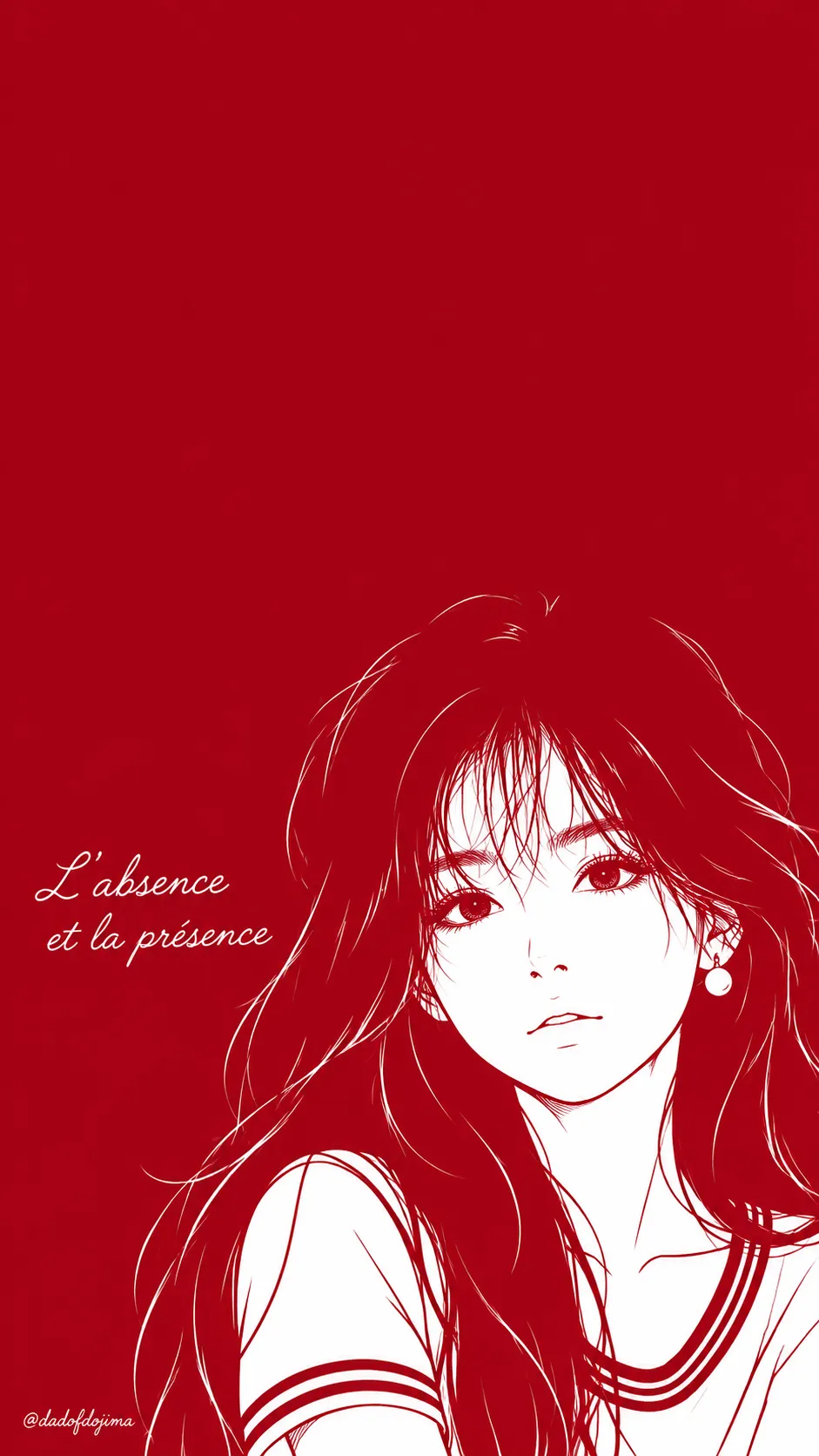
Create a vertical manga-style phone wallpaper from a reference photo, using white figure details against a single saturated background color and a French handwritten phrase.
Example outputs
Prompt template
- Format
- Markdown Parameterized
- Inputs
- Reference_photo (image) · Required watermark (text) · Optional · Default: @dadofdojima
- Outputs
- Finished_wallpaper (image)
Create one finished image in a single pass, in a 9:16 vertical phone-wallpaper aspect ratio.

Use the uploaded photo only to make the subject recognizable through its features, hairstyle, outfit, and distinctive accessories. First determine whether the photo shows a person or an animal/animal character: preserve that subject and do not turn an animal into a human. Show only one main subject; if the photo contains several people, use the most prominent one.

Do not copy the photo’s head angle or tilt, face direction, gaze, expression, lighting, background, or framing. Draw the face almost frontally, turned very slightly toward the left of the frame, with the head tilted slightly to the subject’s left and the chin slightly down. The eyes look straight at the viewer. Give the subject a calm, quiet, slightly blank, dreamy expression, with a short closed mouth line and a tiny simple nose mark. Redraw the face in clean manga style while keeping the eyes, nose, and mouth proportions and placement recognizable from the photo. Do not beautify, average, or symmetrize the features, or substitute a generic anime face.

Use a minimalist, inverted two-tone Japanese manga style: exactly two flat colors throughout the image—the single randomly selected KEY COLOR and pure white (#FFFFFF). Choose one saturated, mid-to-dark hue freely from the full color wheel. Do not default to a habitual color or choose blue merely because it is common in this style; blue is acceptable only if the random selection genuinely lands on it. Use that same flat KEY COLOR everywhere specified. No third color, gradients, gray, shading tones, screentone dots, texture, or paper grain.

Render all areas that would ordinarily be black or dark—including hair, eyelashes, irises, pupils, eyebrows, line art, cast shadows, and the mouth line—in the KEY COLOR, which must match the background. Render skin and light areas in pure white. The white shapes define the figure. Use clean, thin, confident Japanese manga ink lines in the KEY COLOR, with delicate lines for the collarbone, neck, ear, and jaw. Keep edges crisp and vector-like, with no color blending into a third tone; do not use 3D, painterly, or photorealistic rendering.

Make the hair a solid KEY COLOR mass with no outline against the background, so its silhouette disappears into the background. Show only a few thin white gaps or strand lines where hair falls over the white face and shoulders, such as bangs over the forehead and side locks over the cheeks and shoulders. Follow the photo’s hairstyle and hair length. Draw large manga eyes with KEY COLOR irises, white crescent and dot highlights, a thin KEY COLOR upper lash line, and a white inner gleam, for a soft, slightly glossy look.

Use a bust crop showing the head, neck, collarbones, and tops of the shoulders. Cut off the shoulders at the bottom edge and the right shoulder at the right edge. Place the figure in the lower-right, with the face center around 70% from the left and 70% from the top. Put the top of the head around the middle of the canvas; because the hair matches the background, the upper approximately 55% should read as empty solid negative space. Keep the face moderately large, roughly 40% of the canvas width, and fully detailed at that size. Leave the upper half completely empty—no text, objects, or decoration—so it can be used for a phone clock. Keep the left side empty apart from the phrase below.

Use the outfit from the photo, simplified into white areas with thin KEY COLOR lines and KEY COLOR shadow shapes only. Clearly show the neck and collarbones with the neckline opening. If the photo shows no clear clothing, use a simple off-shoulder or wide-neck top. Preserve distinctive accessories such as glasses or earrings using KEY COLOR lines and white fills.

Write exactly this French phrase, with no spelling or wording changes, on two left-aligned lines:
L’absence
et la présence

Use delicate, thin monoline handwritten pen script: elegant connected cursive with an even fine stroke weight matching the manga line art, slightly airy letter spacing, and a natural handwritten feel. Do not use heavy brush calligraphy or thick-and-thin flourishes. Use pure white only. Spell the phrase exactly: capital L followed by an apostrophe in “L’absence”; “absence” and “présence” both end in “-ence”; the “é” in “présence” must have its acute accent clearly visible; “et la” is lowercase. Keep every letter legible. Place the phrase in the empty left area at the subject’s eye height, around 62–70% from the top, starting about 8% from the left edge. Keep it clear of the subject’s head and hair with a comfortable margin. Make its total width about 35–40% of the canvas, small and quiet so it does not compete with the face.

Draw the signature `${watermark:@dadofdojima}` exactly once, very small and in white, in the bottom-left corner on the KEY COLOR area. Keep it clearly separate from and much smaller than the phrase. Do not add any other text, translations, logos, frames, or borders.

Avoid any color other than the single KEY COLOR and pure white; pale, pastel, light, or washed-out KEY COLOR choices; black lines or black hair; gradients, gray tones, soft shading, screentone dots, or textures; an outline separating the hair from the background; centered, full-body, or waist-up framing; copying the photo’s head angle, gaze, or expression; a generic anime face that does not resemble the reference; photorealistic or 3D rendering; misspelled, missing, or extra phrase letters, a missing apostrophe, or a missing accent on “é”; thick brush calligraphy or heavy decorative script; text in the upper half or overlapping the face or hair; a second instance of the signature; or nudity.
Replace the ${…} placeholders with your values
before using this prompt. See parameters
and defaults below
Parameters
Replace each placeholder with your own value, or use its default when one is provided
${watermark:@dadofdojima}
watermark
Default: @dadofdojima
What you'll create
The reference figure is redrawn low at the right while the upper half stays open. Recognizable hair, outfit and accessories sit within a minimal illustrated treatment rather than photographic rendering.
Usage instructions
Provide the reference photo; it supplies recognizable features, hairstyle, outfit, and accessories, while the prompt replaces its pose, gaze, expression, lighting, and framing. The composition fixes the subject in the lower-right and reserves the upper half as empty space; the background hue is chosen randomly, so the prompt does not offer a preferred-color setting.
Frequently asked questions
If several people are shown in the photo, are all included?
No. The most prominent subject is selected.
May an animal reference become a human?
No. The original subject species remains.




Comments
Tried this prompt? Share what you made, compare results, or ask a question