Raven-Wing Double-Exposure Portrait
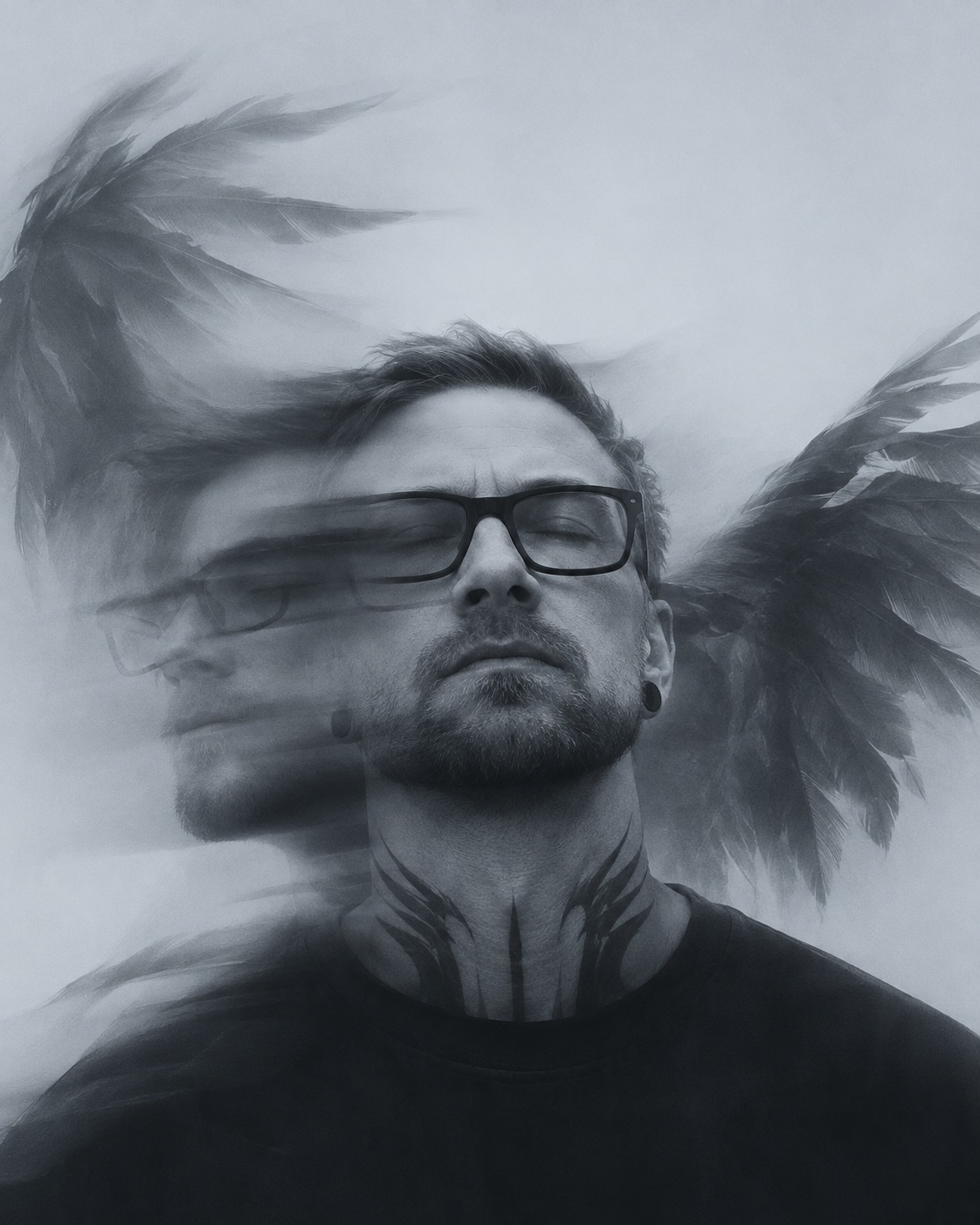
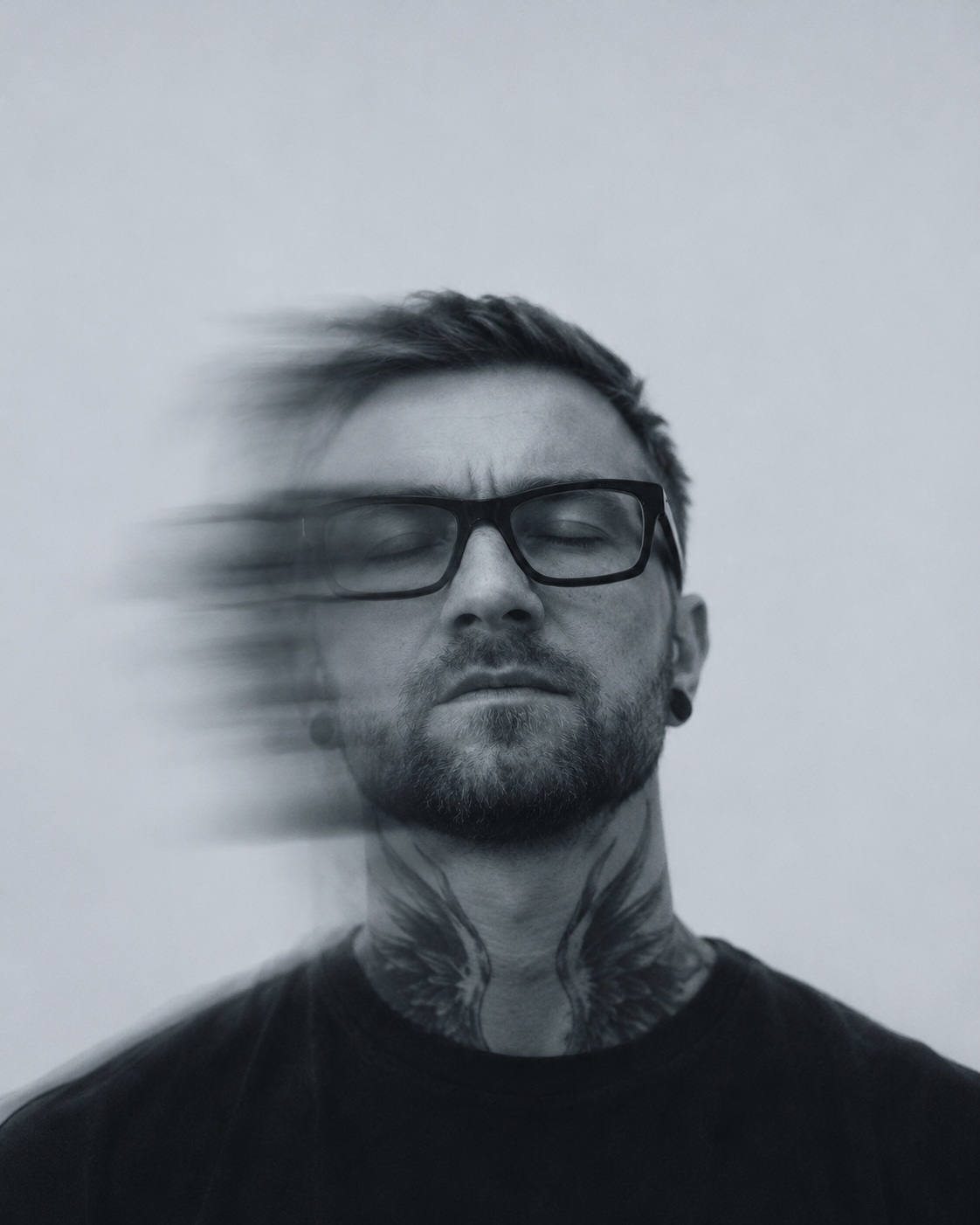
Create a restrained black-and-white fashion portrait with a crisp, identity-preserving face, a leftward motion-blurred double exposure, and translucent raven-wing imagery.
Example outputs
Prompt template
- Format
- Text
- Inputs
- Identity_reference (image) · Required
- Outputs
- Portrait (image)
Create an ultra-photorealistic avant-garde photographic portrait: a minimalist black-and-white experimental fashion editorial combining controlled double exposure, subtle long-exposure movement, and original raven-wing imagery. Use a vertical 4:5 composition. The photograph should feel like an authentic fine-art darkroom composite, not an AI illustration.

STRICT IDENTITY LOCK

Use the uploaded selfie or portrait as the primary and immutable identity reference. Depict the exact same real person. Preserve the individual’s facial bone structure, forehead, eye spacing, nose bridge and tip, mouth and lips, cheek shape, chin and jawline, natural proportions, skin tone translated into monochrome, authentic age, and slight asymmetries.

Retain their actual hairstyle and hair length, facial hair pattern and density, and recognizable expression. If the reference shows rectangular glasses, preserve the precise frame shape and clear optical lenses without distortion; if it shows ear gauges or other visible piercings, retain them accurately.

Do not invent glasses or piercings for a subject who does not have them. Do not beautify, swap faces, change age, or add generic model features. The main face must remain recognizable at first glance.

FRAMING AND POSE

Use portrait orientation, 4:5. Show a single centered person from the upper chest upward, facing mostly forward.

The head is slightly raised, the chin gently lifted, and the eyes naturally closed as though absorbed in a quiet moment. Use relaxed lips and an introspective expression rather than a dramatic pose.

Dress the person in a plain, heavyweight black crew-neck T-shirt with believable cotton fabric and no graphics.

Maintain the subject’s real short haircut if the reference shows short hair; do not add the long, flowing hairstyle of the inspiration image.

The person remains fully human. Include no hands, raised arms, accessories being held, or gesturing.

Leave a generous area of pale empty space above the head and breathing room around the shoulders.

THE DOUBLE EXPOSURE — PRIMARY VISUAL EFFECT

Keep the dominant central face optically crisp and anatomically stable, with natural skin and realistic edges.

Layer in a second, semi-transparent photograph of the same subject as a slightly left-facing profile, shifted to the left side of the frame and at the same photographic scale.

Blur this secondary exposure horizontally, with elongated ghost trails running leftward across the hair and side of the head, like a brief movement recorded on slow film.

Keep the duplicate softly recognizable at lower opacity, gradually dissolving into the pale background.

Allow only very restrained secondary echoes at the edges to make the image feel captured through a real multi-exposure process.

Never blur or reshape the main nose, lips, glasses, or jaw. Do not create separate portrait panels, a symmetrical triple-face montage, or a solid second person.

ORIGINAL RAVEN-WING IMAGERY

Introduce an artistic overlay of black raven wings with realistic feather anatomy and layered transparency.

Behind the main head, have one large wing sweep diagonally upward into the right-hand negative space. Its feathers form a soft, dynamic silhouette that blends into the photographic shadow.

Have a second translucent wing emerge across the lower-left shoulder and dissolve into fine feather trails and the blurred profile exposure.

Some wing edges may disappear into misty silver-gray gradients; others remain lightly detailed.

The wings should suggest transformation, movement, and dark elegance without looking like physical costume wings attached to the person’s back.

Do not include an oversized bird head or literal fantasy creature. Make the wing shapes original, not a tracing of the inspiration photograph.

NECK TATTOO — NEW DESIGN

Add an original, tasteful blackwork neck tattoo inspired by the two folded wings of a raven.

Two tapered clusters of individually readable dark feathers rise symmetrically from beneath the T-shirt collar along the left and right sides of the throat, with a narrow, clean central gap.

Use angular but organic feather geometry, fine shaded transitions, and careful negative space.

Make the ink look realistically embedded in the skin rather than like a digital sticker.

Keep it below the jawline, do not cover the face, and do not use letters, runes, or copied ornaments.

Preserve any existing visible tattoo from the reference when it conflicts; do not overwrite recognizable permanent marks.

MONOCHROME COLOR SCIENCE

Make the entire image black-and-white with a restrained cool blue-silver tonal bias, rather than plain neutral grayscale or teal.

Use icy gray highlights, pale silver mist, soft graphite shadows, and deep natural black in the shirt and wing details.

Add a very gentle blue cast to the brightest grays, with dimensional but restrained contrast.

Use an almost-white, subtly textured cool-gray studio wall as the background, with open negative space, no scenery, and no colored lights.

Strictly avoid greenish blacks, cyan neon, warm sepia, brown, orange, or saturated blue.

PHOTOGRAPHIC EQUIPMENT AND OPTICS

Use authentic medium-format fashion portrait rendering, as if captured on Hasselblad X2D 100C with a 90mm portrait lens, aperture f/4–f/5.6, natural 85–90mm perspective, and precise focus on the principal face.

Keep the main exposure sharp with delicate optical detail. The left echo should appear to come from a second long exposure at roughly 1/8 second with deliberate lateral movement, composited organically in-camera.

Do not digitally distort facial structures.

Use delicate analogue-inspired grain and subtle optical halation in bright areas, minimal vignette, and realistic depth falloff.

Keep texture fine instead of adding strong digital clarity.

LIGHTING

Use soft overcast daylight or a large diffused octabox positioned high and 45 degrees camera-left; add low-intensity broad white bounce fill on camera-right and delicate edge light on the short hair, upper shoulders, and wing feather edges.

Create smooth shadow transitions over the cheeks and neck, with no hard specular beauty highlights.

Light the primary face and its ghost exposure consistently, with soft luminous fog in the negative space.

Use natural photographic exposure, with no HDR or hard contrast sharpening.

REALISTIC MATERIAL DETAIL

Show authentic small pores and skin tonal variations, natural beard strands and eyebrows, true lashes, subtle lip texture, correct ears and eyeglass geometry, matte cotton grain, and real tattoo pigment.

Keep the realism tactile but soft, not pore-exaggerated or hyperprocessed.

Preserve the person’s emotional stillness while the layered movement happens around them.

FINAL ART DIRECTION

Create high-end experimental portrait photography, fine-art double exposure, understated contemporary fashion editorial, minimalist composition, poetic movement, quiet melancholy, and raven symbolism.

Emphasize personal identity and restraint over effects.

Keep the photograph clean, credible, and timeless, with a subtle surreal element that reveals itself on closer inspection.

STRICT NEGATIVE CONSTRAINTS

No changed identity, unrecognizable generic face, artificially aged subject, long hair unless present in the reference, hands, extra fingers, fully visible second person, mismatched anatomy, duplicated main eyes, excessive blur across the central face, dirty grunge, green tint, warm tones, neon cyberpunk, big glowing graphics, CGI, 3D render, cartoon, plastic skin, airbrushed face, oversharpening, HDR, typography, logos, or watermark.

PRIORITY:
Facial resemblance > sharp central face > authentic motion-blurred left echo > cool blue-silver black-and-white grade > original raven wings > natural neck tattoo > fine-art photographic realism.

Aspect ratio 4:5.
What you'll create
A calm figure with closed eyes remains crisp at the center while a translucent profile trails leftward through pale silver-grey space. Raven-wing overlays and a feather-inspired neck tattoo add dark elegance, balanced by soft diffused light, a plain black shirt and restrained blue-silver toning.
Usage instructions
Frequently asked questions
Are the wings meant to be a physical costume?
No. They are transparent photographic overlays that blend with shadow and movement, rather than wings visibly attached to the person's back.
Should the new neck design overwrite an existing tattoo?
The template says to preserve recognizable permanent marks from the reference when they conflict with the proposed raven-inspired tattoo.
Must glasses or piercings be added to every portrait?
No. Preserve them only when present in the reference, including the real frame shape and clear lenses. The template explicitly says not to invent those accessories.



Comments
Tried this prompt? Share what you made, compare results, or ask a question