- Category
- Photography
Between the Tide and Night — Cyan & Amber Editorial
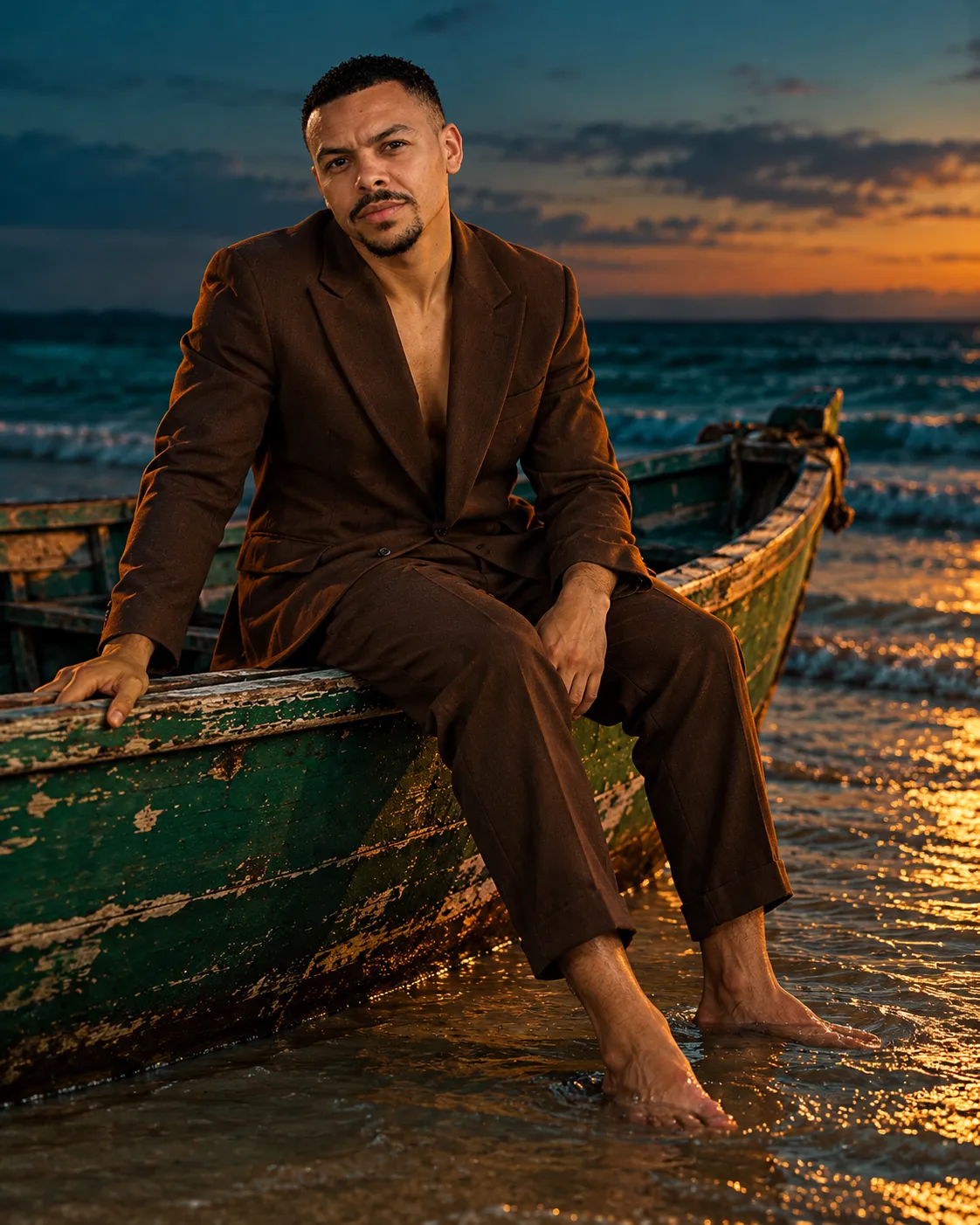
Create a photorealistic, cinematic fashion editorial of an adult sitting barefoot on an old wooden fishing boat at dusk, lit in cyan and amber.
By Threads — Published on — Modified on
Example images
Prompt template
- Format
- Text
- Inputs
- Personal_Reference_Photo (image) · Required
- Outputs
- Editorial_Photograph (image)
Create a single photorealistic vertical 4:5 editorial photograph of an adult sitting on the edge of an old wooden boat at the shore of a beach at dusk. Their bare feet gently touch the shallow water.

Apply a CYAN & AMBER • LUMINOUS DIFFUSION • ANALOG CINEMA aesthetic: cool and warm light coming from distinct directions, deep shadows, localized optical glow, and the texture of scanned color negative film.

IDENTITY AND EXPRESSION
Use the supplied personal photograph as the identity reference. Preserve the subject’s features, apparent age, hair, skin tone, facial hair when present, and natural body proportions.

This prompt is suitable for any gender; preserve the individual characteristics of the reference.

Give the subject a calm, contemplative expression, naturally closed mouth, and head turned slightly toward the camera. Their gaze should be direct and relaxed. Preserve pores, small asymmetries, and natural variations in the skin; avoid excessive retouching.

WARDROBE — BROWN TAILORING
Dress the subject in a complete chocolate-brown suit: a blazer and trousers made from the same fabric. The tailoring should have a slightly loose fit, with convincing weight, seams, and folds.

The blazer is worn directly against the skin, with no shirt underneath. Its front is subtly double-breasted, with a low closure that reveals only the upper chest. Keep the bust covered regardless of anatomy; do not expose nipples.

The tailored trousers have a regular length, with hems slightly turned up above the ankles so they do not dip into the water. Include natural folds at the hips and knees caused by the seated pose.

The subject is barefoot. Add no accessories unless requested in the main prompt.

POSE AND CONTACT WITH THE WATER
Seat the subject on the boat’s side edge near the bow, with their body turned three-quarters and both legs facing outward from the boat.

Their hips rest on a broad, structurally plausible wooden surface. Keep the torso relaxed, shoulders low, and posture balanced.

One hand rests on the boat’s edge to help support the body; the other rests on the thigh. Hands must be anatomically correct, with spontaneous gestures.

Keep the legs close together, with knees gently bent. One foot touches the water with its toes; the other is slightly more submerged, creating distinct small ripples.

Show realistic contact between skin and water: localized reflections, subtle distortion of submerged toes, and small ripples around the feet. Avoid floating or duplicated feet.

BOAT — AGED WOOD AND PEELING GREEN PAINT
Show a small traditional wooden fishing boat, aged by use and sea air.

Its hull is painted dark military green, between deep olive and moss green, with irregular peeling paint. Some areas reveal grayish wood; others show older layers of paint.

Preserve the planks, joints, small cracks, and subtly oxidized hardware. Wear should follow the edges, points of friction, and areas near the waterline.

The boat remains intact and capable of supporting the subject. Do not turn it into a wreck or a stage prop.

The boat rests partly on wet sand and partly in shallow water, stable and with coherent scale and perspective.

BEACH AND FRAMING
Set the scene on a quiet beach in the early evening, with a strip of wet sand, calm sea, and a faintly visible horizon.

Position the camera in front of and slightly to the side of the boat, approximately level with the seated subject’s torso. Frame the subject in full, including their feet and the small ripples, as well as enough of the hull to show its color and texture.

Keep the subject as the main focus. Use the boat’s diagonal edge to lead the eye toward their face.

The background has a deep blue-green sea, a darkening sky, and few distant details. Do not automatically add palm trees, buildings, other boats, or people.

LIGHTING — CYAN AND AMBER
Cool ambient light from the sky, rendered in cyan and turquoise, comes from one side and illuminates parts of the face, suit, hull, and water surface.

An off-camera warm light source on the opposite side, situated on the beach, emits golden-yellow and amber light. It reaches the side of the subject and parts of the wood, creating warm reflections on the nearby water.

The warm source should feel physically present in the environment, like a nearby coastal light, without requiring a visible lamp in the photograph.

Distribute the colors according to the forms. Do not divide the face and body into two perfectly uniform halves. Allow slight yellow-green transitions on surfaces receiving both light sources.

Preserve depth by keeping shadowed areas between the illuminated regions.

COLOR AND MATERIALS
The suit should remain recognizably chocolate brown under the colored lighting. The boat should retain its dark military-green base color.

Cyan and amber reflections fall in localized areas on the skin while preserving natural gradations and recognizable features.

Render the water in deep blue-green and green, with golden reflections near areas reached by the warm light. Reflections should follow the ripples and the position of the light sources.

Clearly distinguish matte fabric, worn wood, skin, and wet surfaces. Do not give every material the same shine.

DIFFUSION, CONTRAST, AND FOCUS
Apply perceptible optical diffusion mainly to the brightest golden areas and small reflections on the water.

Keep the glow localized rather than forming a uniform haze. Preserve deep shadows inside the boat and in the suit’s folds.

Use moderate-to-strong contrast while retaining enough midtones in the face. Highlights should be soft and must not erase detail in the skin or fabric.

Keep the eyes, main facial features, hands, and the feet’s contact with the water legible. Separate the background gently while keeping it recognizable.

Do not apply motion blur to the body. If a light breeze is present, allow only slight movement at the hair tips or blazer edges.

TEXTURE AND CAPTURE REFERENCE
Give the photograph the appearance of scanned 35 mm color negative film, with fine-to-medium, irregular grain integrated throughout the image.

Use ISO 400–800 as an aesthetic reference, the perspective of a 50 mm lens, and an aperture appearance close to f/4, adapted to keep the subject, boat, and feet legible. These parameters guide the look and do not imply a specific historical capture.

Use delicate sharpness, moderately reduced microcontrast, and slight variations in density. The photograph should convey a real presence on the beach: weight on the wood, fabric following the body, feet in the water, and lighting shared across all elements.

AVOID
Altered identity, an artificially muscular body, intimate exposure, a floating blazer, a suit turned black, a new-looking boat, uniform wear, melted wood, incorrect anatomy, duplicated fingers, feet not in contact with the water, incoherent reflections, flat colored lighting, plastic skin, excessive shine, HDR, aggressive sharpening, generalized blur, smoke, cigarettes, CGI, painting, collage, text, logos, borders, and watermarks.




Comments — 0