- Category
- Photography
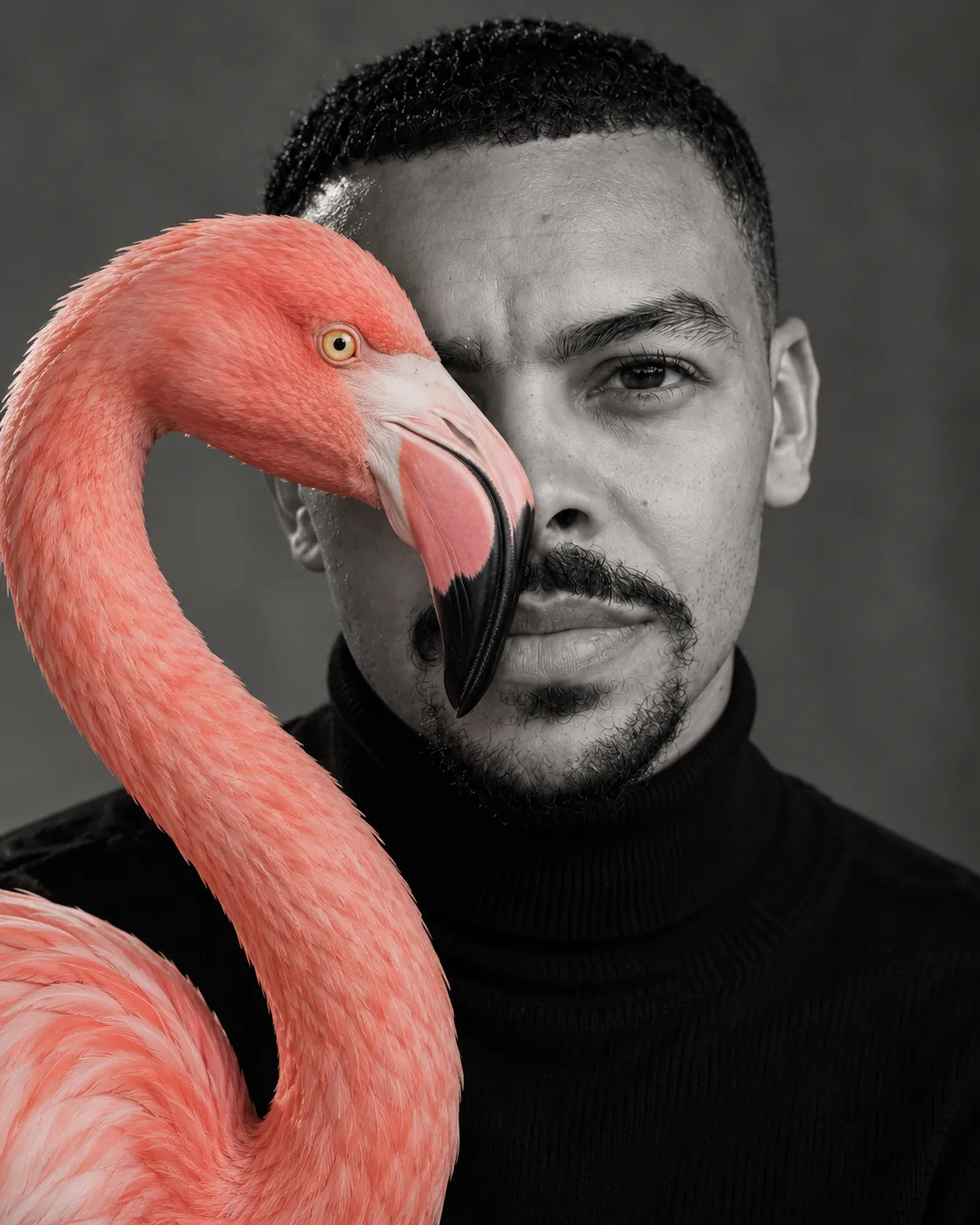
Cinematic Flamingo Eye-Alignment Portrait
Create a photorealistic editorial portrait of an adult with a pink flamingo, precisely aligning the bird’s eye with the person’s obscured eye. Render the person and setting in black and white while preserving the flamingo’s natural colors.
By Threads — Published on — Modified on
Example images
Prompt template
- Format
- Text
- Inputs
- Identity_reference_photo (image) · Required
- Outputs
- Editorial_portrait (image)
Create a single photorealistic vertical 4:5 editorial photograph of an adult person with a pink flamingo in the foreground. Use a tight crop from the upper chest to slightly above the head.

The person wears a black turtleneck that covers the entire neck up to below the chin. Render the person and setting in black and white; only the flamingo retains its natural colors.

Use a cinematic visual language inspired by sophisticated dramas of the 2000s, with a soft digital HD appearance aesthetically guided by the Sony CineAlta F23: broad, directional lighting, rich midtones, deep shadows, and subtle texture. Prioritize the impression that the person and bird were photographed together.

IDENTITY AND EXPRESSION
Use the provided personal photograph as the exclusive identity reference. Preserve the person’s face shape, apparent age, proportions, hair, eyebrows, eyes, nose, mouth, jaw, and facial hair where present. This prompt is suitable for any gender; preserve the individual features in the reference.

The person faces the camera with relaxed shoulders, an upright head, and a serene expression. The visible eye looks directly into the lens; the mouth is naturally closed.

Preserve small asymmetries and skin texture appropriate to the camera distance. Do not reshape the face or artificially emphasize pores or hairs.

COMPOSITION — EXACT EYE-TO-EYE ALIGNMENT
Place the flamingo between the camera and the person, with its head in profile on the left side of the image and its beak pointing right, toward the center of the face.

The center of the flamingo’s pupil must occupy the exact projected position of the person’s obscured pupil. Merely placing the bird near the eye or eyebrow is not sufficient.

Use the person’s real facial proportions to position the bird. The flamingo’s eye and the person’s visible eye should read visually as a pair, respecting the eye line and natural distance between them.

Adjust the bird’s position, distance, and apparent scale to achieve this alignment. Do not shift the human eye or distort the flamingo’s anatomy.

The bird’s head physically occludes the corresponding eye through overlap. Keep the person and animal anatomically separate, with no merging of skin and feathers.

The other human eye remains completely visible. The beak projects into the composition and curves downward near the side of the nose, while leaving the mouth and uncovered eye readable.

The flamingo’s pink neck descends in an organic curve through the foreground, in front of part of the chest, and continues beyond the bottom edge. Keep the bird’s body outside the frame.

EARS AND OVERLAPS
Preserve the natural position and shape of the ears. Depending on perspective, the ear nearest the flamingo may be fully hidden by the bird’s neck.

Do not create detached ear fragments, duplicated ears, or patches of skin between feathers. Maintain anatomical continuity in partially occluded areas.

PHOTOGRAPHIC INTEGRATION
The person and flamingo must share the same lighting, perspective, exposure, contrast, and optical response.

Position the bird slightly in front of the face, with plausible physical separation. Where it blocks the light, cast soft, coherent shadows on the skin and turtleneck. Shadow softness should correspond to the distance between the elements.

Preserve small feathers along the contours, with natural definition and subtle optical softness. Avoid overly sharp edges, halos, dark cutout lines, or resolution differences between the person and bird.

The result should look like a single photograph treated with selective color.

SOFT, DIRECTIONAL LIGHT
Use a broad, diffused light source slightly above eye level and offset to one side of the camera, like light from a large window.

Light the face, feathers, and fabric from the same direction. Maintain gradual transitions between light and shadow, subtle fill, and small reflections in the eyes.

Preserve volume beneath the eyebrows, nose, beak, and chin. Do not use direct flash, flat frontal lighting, or artificial rim lighting.

BLACK AND WHITE WITH NATURAL PINK
Convert the person, turtleneck, and background to black and white, retaining rich tonal gradations and material distinctions.

Keep the flamingo in soft pink, salmon, and subtle coral, with natural variation in its feathers. Preserve the natural coloration of its eye and beak, including the dark tip.

Use moderate saturation. Lit feathers should be lighter, while shadowed areas retain depth. Do not turn the bird into a uniformly pink surface.

Apply selective color while preserving fine feathers, transparency, and focus transitions, with no pink spill onto the skin or clothing.

WARDROBE AND BACKGROUND
The person wears a matte, fine-knit black turtleneck with realistic drape and small folds. No accessories, patterns, or logos.

Use a simple, physical medium-gray background with subtle variations in brightness. Keep enough separation to distinguish the hair and shoulders without artificially cutting out the silhouette.

PERSPECTIVE, FOCUS, AND TEXTURE
Use a portrait perspective visually equivalent to approximately 85 mm on full frame, as a visual guide, with enough distance to preserve facial proportions.

Use enough depth of field to keep both the visible human eye and the bird’s eye in focus. Adjust aperture, distance, and the elements’ positions as needed. Let the background gradually lose definition.

Keep definition clean, with delicate contours and moderate microcontrast. Skin should show natural pores, feathers fine structure, and fabric a subtle weave, without overemphasizing every detail.

Aim for a well-exposed digital HD appearance with very fine, low-contrast texture, visually inspired by ISO 200–400. These values are aesthetic guidance, not confirmed Sony F23 settings.

Do not add strong analog grain, aging, or paper texture. Keep the face and bird stable, without motion blur.

CONTRAST AND FINISH
Use moderate contrast, rich midtones, deep blacks with retained detail, and preserved highlights.

The image should convey physical presence through shared lighting and convincing depth. The eye alignment creates the editorial effect; textures, shadows, and proportions support realism.

AVOID
A bird’s eye positioned above or below the occluded eye; incoherent distance between the two visible eyes; deforming the face to accommodate the bird; malformed ears; skin fragments; a disproportionately large flamingo head; anatomical fusion; a hidden mouth; neon pink; visible cutout edges; engraved-looking skin texture; excessively sharp feathers; aggressive sharpening; plastic skin; direct flash; strong grain; vintage filters; HDR; halos; CGI; painting; collage; borders; text; and watermarks.




Comments — 0