- Category
- Photography
The Last Exorcist: Halloween Hunter — Vintage Photo Booth
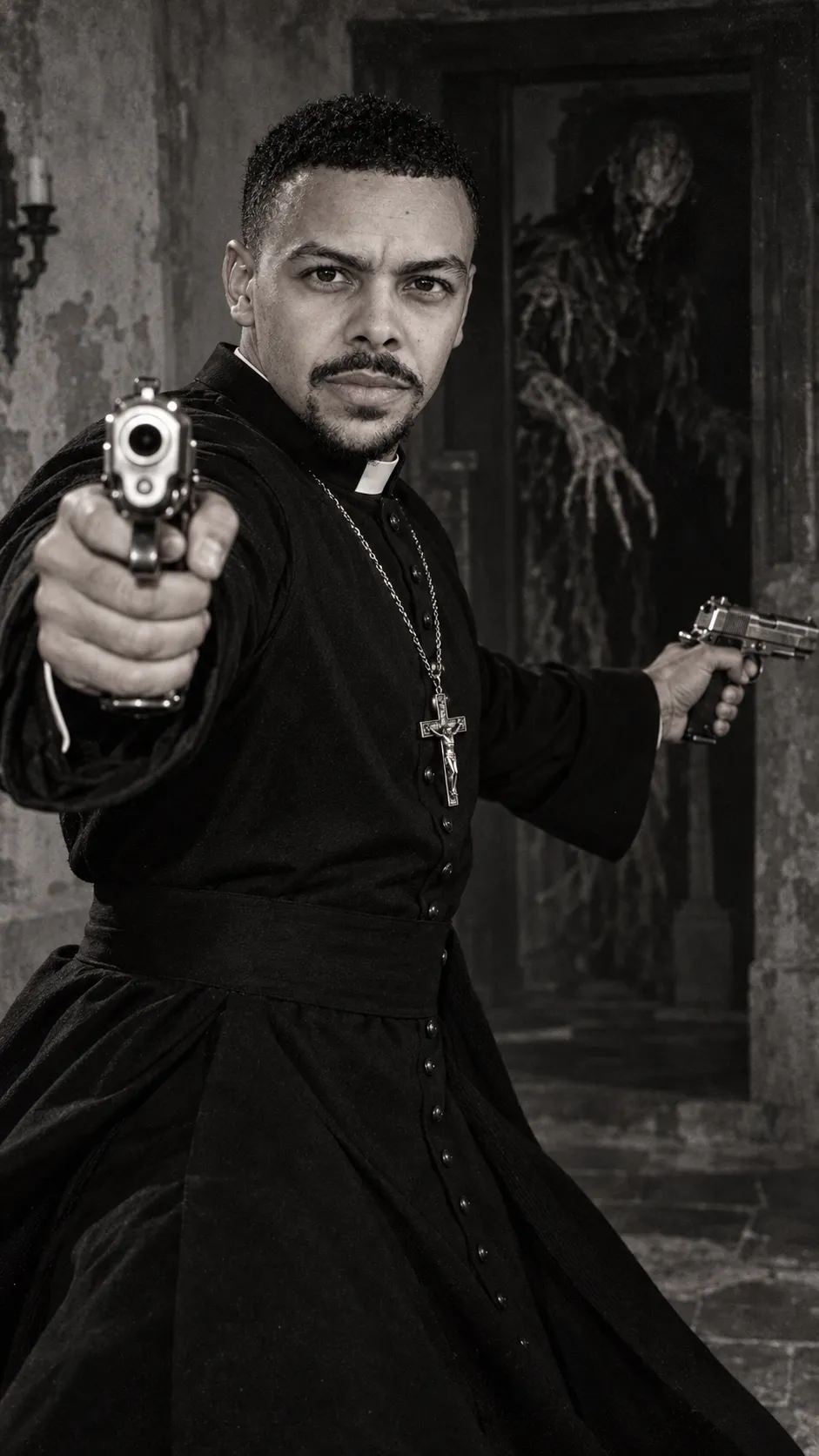
Create a photorealistic monochrome Halloween action portrait of an adult monster-hunting priest, styled like an aged photo-booth print.
By Threads — Published on — Modified on
Example images
Prompt template
- Format
- Text
- Inputs
- Reference_photo (image) · Optional
- Outputs
- Generated_photo (image)
Create a single vertical 9:16 photorealistic black-and-white photograph of an adult person dressed as a priest who hunts monsters, in a fictional Halloween scene.

Combine the look of an old photo-booth portrait with a moment of action: direct frontal flash, organic grain, dense gray tones, optical softness, and subtle motion at the edges.

IDENTITY AND CLOTHING
If a personal reference photo is provided, preserve the person’s identity, apparent age, facial features, hair, facial hair, skin tone, and natural proportions exactly.

Dress the person in a heavy black cassock with a white clerical collar, small front buttons, and convincing drape. The lower part of the cassock should follow the body’s rotation softly.

A silver crucifix hangs around the person’s neck over the chest and catches a small reflection from the flash. The chain and crucifix shift subtly with the turn.

Place a cinematic-looking silver pistol in each hand, with realistic metal, localized reflections, and consistent design.

ACTION AND POSE — TURN INTERRUPTED BY THE FLASH
Capture the person mid-turn, with the torso at a three-quarter angle, shoulders rotating, and body weight plausibly supported.

The right arm reaches toward the camera, slightly offset to one side of the face. The pistol points directly into the lens, with the circular opening of the barrel visible from the front.

Keep the gun clearly separate from the face: the barrel must not cover the eyes, nose, or mouth. Use natural perspective foreshortening; do not make the gun or hand enormous.

The left arm remains extended out to the side, with the elbow slightly bent and the second pistol aimed out of frame, suggesting creatures nearby.

The person turns their head toward the camera during the spin. They look directly at the camera with a firm, focused gaze, chin slightly lowered, and mouth closed. Keep the expression controlled, without shock or an exaggerated grimace.

Depict the instant just before the shots are fired, keeping the front-facing barrel clearly visible. Do not use bright explosions that obscure the weapons.

CREATURE IN THE BACKGROUND
Behind the person, partly hidden by the shoulder and darkness, include a Halloween creature: a tall, monstrous humanoid silhouette with elongated hands and subtly perceptible organic texture.

Place the creature a few steps behind the person in the same physical environment. Its presence should be discovered in the background without competing with the main face.

Keep the bodies separate. Do not make the creature emerge from the person’s back or merge its arms, hands, or clothing with theirs.

No blood or explicit injuries.

SETTING AND COMPOSITION
Set the scene in a dark, old interior, with a worn plaster wall and a shadowy passage in the background. Use few elements, just enough to create depth and place the creature in the scene.

Frame from mid-thigh up, including the head and both complete pistols. Leave lateral space for the outstretched arm.

Place the camera near chest height with a slight low angle. The foreground gun creates depth, the face occupies the main plane, and the creature stays in the background plane.

Do not include a physical photo booth in the scene; use only its photographic visual language.

FLASH AND MOTION
Use a small, direct flash close to the lens axis, illuminating the face, white collar, hands, and metallic surfaces.

Keep the environment considerably darker, with light falling off quickly into the depth of the scene. Give the monster only enough residual light to reveal part of its form.

Combine the flash with a slightly prolonged ambient exposure. Keep the face and foreground gun relatively defined; add small motion trails consistent with the turn to the side sleeve, cassock hem, and chain.

Apply subtle, localized blur. Do not create a swirl, radial blur, or duplicate eyes, hands, or weapons.

BLACK AND WHITE AND AGED PRINT
Keep the image entirely monochrome, with dense blacks, rich mid-grays, and softly compressed highlights.

Make the photograph look like a small, old photographic print that has been scanned: slightly reduce contrast in the deepest blacks, and add fine, irregular texture and small variations in density.

Maintain enough contrast to separate the cassock from the background. The white collar and silver should produce controlled bright points.

Keep the aging subtle, with no sepia, heavy stains, decorative scratches, or paper texture over the face.

GRAIN, FOCUS, AND VISUAL REFERENCE
Use small-to-medium grain that is visible and organically distributed across all planes. Keep sharpness moderate, with slight old-lens softness.

Keep the eyes and facial features recognizable. The opening of the front-facing barrel must remain identifiable, with enough depth of field to relate the gun and face.

As aesthetic guidance, simulate ISO 400–800 black-and-white film negative, a 35–50 mm equivalent perspective, and an ambient exposure near 1/30 s combined with flash. These parameters guide the visual result; they are not intended to reproduce a specific historical photographic process.

AVOID
Illustration, CGI, video-game aesthetics, altered face, plastic skin, guns fused to hands, extra fingers, a third arm, distorted barrels, a pistol covering the face, duplicated crucifixes, a creature fused with the protagonist, blood, explicit injuries, fire obscuring the barrel, generalized blur, excessive motion trails, extreme digital sharpness, text, dates, borders, and watermarks.






Comments — 0